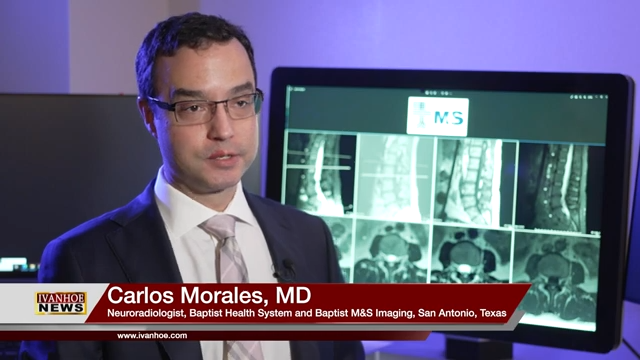
Neuroradiologist at Baptist Health System and Baptist M&S Imaging in San Antonio, Texas, Carlos Morales, MD, talks about how artificial intelligence is changing MRI procedures.
Interview conducted by Ivanhoe Broadcast News in 2023.
You’re utilizing AI to help read MRI’s. That’s a lot of acronyms but encapsulate what it does, just a synopsis.
Morales: The tool that we’re using is AI to reconstruct the images but not to read the images. We still do all the reading. What it does is it’s a deep learning reconstruction algorithm to work with the raw data. That comes out of the scanner from the patient being in the scanner. To reconstruct and produce an image with high resolution, high signal, and decreased scan time compared to a traditional reconstruction algorithm. That was used prior to this for us to get very good-quality images.
Are you talking about a previous reconstruction algorithm that’s been around for how many years?
Morales: Since the beginning of MRI and CT scanning. We’ve always had to turn raw data into images that humans can interpret. What comes out of the scanner is just data packets. We have to turn that into the computer and turn that into an image that we can interpret. Traditionally, the prior reconstructive algorithms. Obviously, there have been tremendous advancements and computing power. But this is the first time that GE has been able to use these deep learning and neural networks to work with that raw data and produce these quality images that we’re seeing.
If you had to assign a percentage increase in quality with this, what would it be?
Morales: I’d say the increase in sharpness, is 20 to 30 percent.
You look at these all day long. That’s what you do, and you interpret their results, but?
Morales: Yes, we were talking about how this also impacts the patient at the other end. What does it do for the patient? The main benefit for the patient is a decrease in scan time. That means a decrease in the amount of time that they have to spend in the uncomfortable MRI scanner on their back. Oftentimes, if they’re getting a scan, there’s a reason for it. It could be back pain; it could be neck pain. Being on their back could be incredibly uncomfortable. If we can cut that scan time. The most tremendous impact of this is decreasing the scan time by a significant amount. Up to 50 percent in some cases averaging about 40 percent across all types of scans. But on cervical spines, for example, a cervical spine, MRI. We’ve been able to reduce the scan time by 49 percent. Almost cutting it in half from 18 minutes, to just over 9 minutes. Which is a tremendous gain.
Are you getting the same results from the actual MRI scan and artificial intelligence assembling all that with their crayon pack? Are you getting different results with AI?
Morales: The data coming out of the scanner is the same. But every time we do a scan, we have a specific protocol, meaning a set of instructions for the scanner to follow. Because of the advancements in this reconstruction algorithm. Those instructions that we give the scanner are for much shorter scans so that we can use the data that comes out of it. Then Recon DL transforms that into an image that we can see that’s at higher resolution and higher signal than the traditional reconstruction algorithms in a much shorter time.
Describe the Recon DL, is that what it’s called?
Morales: From our point of view a Recon DL is literally a black box. The market is using deep learning and neural networks to work with the raw data. Coming out of the scanner and producing these nice images.
Does the AI interpret the scans, or does the doctor still do that?
Morales: The doctor does. It helps us generate the best image quality that we can do in the shortest period. The radiologist is still interpreting every exam.
How has this changed your work life?
Morales: I get a lot more exams without motion artifacts. I get exams with much better diagnostic information, much sharper images, and higher resolution. At the end of the day, I get a much higher percentage of high-quality, highly diagnostic examinations.
Was there a re-learning period or process?
Morales: We go through a long period of training. Anatomy is something that is a huge part of radiology. It’s something that’s ingrained in the field. There is a learning process in getting used to images that are so sharp. We do have a data bank in our mind of what the anatomy should be like, but now and many times, we can see that anatomy more clearly and it helps us make a proper diagnosis.
It begs the question; do you ever find anything untoward because you can see better?
Morales: Small lesions, yes. Any small problems that would have been incredibly subtle or obscured on a lower resolution examination, yes. I’ve been able to see smaller things that I probably wouldn’t have seen before.
Name two or three things that this is done for the patient.
Morales: The main benefit has been a decrease in scan time. Another benefit is that, since our scan times are shorter, we can fit more people onto the schedule, so there’s a decrease in the wait time to get a scan. Then the other main benefit is, if there are any small subtle lesions that we can detect utilizing these higher-resolution exams, we can help find problems earlier than without them.
What about the doctor? You mentioned that anatomy is driven home when you’re in med school, how does this change things for the doctor?
Morales: We can all be a lot more certain in our diagnoses. There’s much less likelihood that we’re going to run across an examination that might be blurred by motion. At the end of the day, we get to do what we’re here for is helping detect pathology, and disease processes in order to help the patients. That’s why we’re here.
Can you give an example of how this has helped someone non-identify, just a general example?
Morales: A general example would be somebody who has severe back pain. They can’t tolerate and they wouldn’t be able to tolerate a 25-minute exam on their back in the scanner. There’s much more likelihood given the scan time, given their discomfort of having motion on the examination. Motion is the radiologist’s enemy on these exams because it blurs things, so we want to do everything we can to reduce motion. By cutting the scan time, the patient should have a much easier time remaining motionless, allowing better quality images, and allowing us to make the right diagnosis.
If Susie came in because she had a problem with her back, she got the scan done and you interpreted that, you found something else, let’s say. Could you use that in a sentence? I’m looking for somebody whose health was impacted by this directly.
Morales: If somebody comes into our imaging center with a, let’s say they have a small tumor. They’re uncomfortable, they’re having a hard time staying still for the scanner for us to get good images. If we can get the scan done or when we get the scan done in a shorter period and have a lower likelihood of motion, somebody comes in for a small tumor that might be pushing on a nerve. If we can get a sharp high-resolution image of the area of interest, we would be able to detect that small tumor with a much higher likelihood than using a traditional reconstruction algorithm that would require an exam that takes twice as long.
Does it ever surprise the surgeons? Does this transfer enter your, in other words, when they’re operating on somebody’s back or head, they’re going to do a better job because of this?
Morales: Number 1, we would detect the issue that they’d be operating on to begin with. Then also they do use images to help navigate them in surgery. Neurosurgeons do that, head-neck surgeons do that, a variety of surgeons do that.
How long have you had this technology and what’s the next step do you think?
Morales: We’ve had it at one of our image centers since ’21 and we’ve then rolled it out subsequently to another three. The plan is to have it at all our centers. It’s a proven thing to us. We’ve demonstrated a decrease in scan times and patient satisfaction. It’s clear this is the way we’re going.
Let’s address the AI issue because they’re good partners in crime until they’re not and they move in and try to do your job. Do you ever see this interpreting data rather than just putting it together?
Morales: This particular system, no. However, there is research on utilizing AI to detect pathology. Yes, that is being used. There have been papers that have come out for utilizing AI to detect breast lesions in mammography with some success. I see that as an important tool to help make radiologists become more efficient and really provide care for more patients that are basically at with a high quality of detection.
How does a patient make sure they’re getting this if they go to a random center in your system? How do they ask for it?
Morales: They ask for it that will be, my name. They can just say I want the faster scan with Air Recon DL.
END OF INTERVIEW
This information is intended for additional research purposes only. It is not to be used as a prescription or advice from Ivanhoe Broadcast News, Inc. or any medical professional interviewed. Ivanhoe Broadcast News, Inc. assumes no responsibility for the depth or accuracy of physician statements. Procedures or medicines apply to different people and medical factors; always consult your physician on medical matters.
If you would like more information, please contact:
Natalie Gutierrez
Natalie.gutierrez@baptisthealthsystem.com
Sign up for a free weekly e-mail on Medical Breakthroughs called First to Know by clicking here