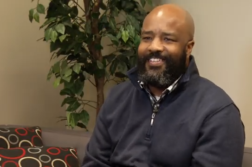
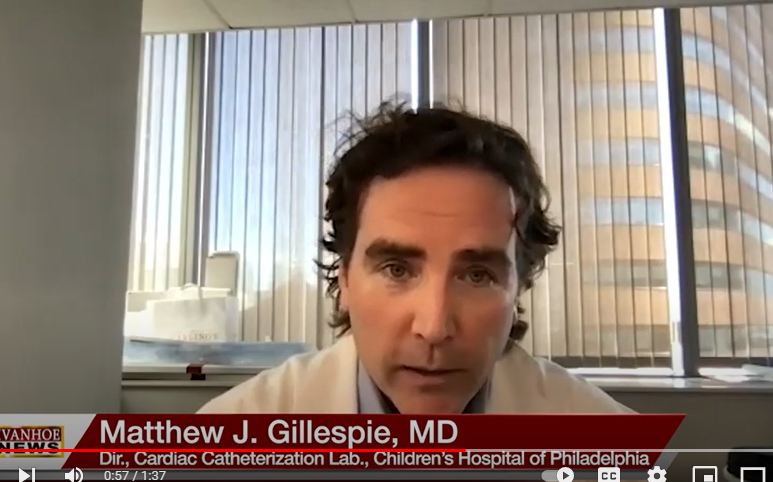
Dr. Matthew Gillespie, MD, director of the Cardiac Catheterization Lab and interventional cardiology at Children’s Hospital of Philadelphia, talks about new heart valve that changed Russell Soloway’s life.
Interview conducted by Ivanhoe Broadcast News in January 2022.
What did Russell’s condition, Tetralogy of Fallot, entail?
DR GILLESPIE: Russell had Tetralogy of Fallot, which is a very common congenital heart defect that we see in patients. In fact, it’s one of the most common defects that we see, and a congenital defect is something that you’re born with. As his heart formed in utero, developing as a baby, he was born with a very common combination of problems. One was that he had a hole in his heart between the bottom two chambers, and the second most important component of that is he had limited blood flow into his lungs through his pulmonary artery. He had an obstructed pulmonary outflow tract and a hole in his heart, and there’s a combination of other things that go along with it. So, that’s a very common combination of lesions that we see in patients with congenital heart disease, and it’s called Tetralogy of Fallot.
For patients who have this condition, is it life-threatening and does it require surgical repair?
DR GILLESPIE: Yes. Tetralogy of Fallot, especially in its extreme form, can be fatal. It can be fatal in infancy if you don’t have an intervention that allows for blood to make it into the lungs. Russell had a form of Tetralogy of Fallot that, based on his medical records from the ’70s, was milder in form, so he didn’t need an urgent intervention as an infant. But as he got into his toddler years, somewhere around age 3, he became symptomatic, and he needed surgery. So, he went to open heart surgery back in the early ’70s.
What did surgeons have to do to repair it at that time?
DR GILLESPIE: At that time, to repair Russell’s heart, they had to open his chest, place him in a cardiopulmonary bypass machine, open up his heart, close the hole in his heart and place a patch over the connection between his heart and his pulmonary artery so that connection between the right ventricle and the pulmonary arteries was unobstructed.
Was it considered major surgery since you’re opening the chest?
DR GILLESPIE: Yeah, that is as invasive as you can be on a human being. It’s a major open-heart surgery and at that time in the ’70s, it was still a relatively new procedure. I think the first cardiopulmonary bypass surgeries happened in the early ’50s, and it really started to mature as a field in the ’60s and ’70s. Russell had a significant congenital heart disease that required operation at a time when surgery wasn’t really mature for that combination of lesions.
As he grew, was it likely that he would need surgery again? Do patients with this condition need surgery?
DR GILLESPIE: Russell had what we call a successful surgery to repair his Tetralogy of Fallot. He had a relatively normal childhood. But even patients who have successful surgery as an infant are left with important residual lesions that need to be followed over time. One of the most common problems that patients like Russell is pulmonary valve regurgitation. In order to allow for unobstructed flow from his right ventricle into his pulmonary artery, the surgeons had to put a patch across the area where you would normally have your pulmonary valve, which functions to keep blood flowing in one direction so that it doesn’t regurgitate back and forth. Russell was left with severe pulmonary valve regurgitation despite his successful surgery.
What were Russell’s options as he got older? What kind of symptoms was he starting to feel?
DR GILLESPIE: Russell had a remarkable life despite starting out with a very significant heart disease. He was a very active kid, a very active young adult, and very active middle-aged adult. When I met him, four or five years ago, he was starting to feel that he was having more difficulty with regular activities. His exercise tolerance was down, he was feeling more tired than usual, than he had been in years. We see that very commonly in patients who have chronic pulmonary valve regurgitation. When you see that, you start to see evidence on his noninvasive imaging, like his echocardiogram or his MRI, that his ventricles, the squeezing chambers of the heart, are starting to suffer, meaning that they’re not squeezing as robustly as they had previously. When you see that in patients who are starting to report activity intolerance, it’s time to replace the pulmonary valve.
What kind of options was he left with?
DR GILLESPIE: Up until recently, with the advent of these new technologies, the only option for patients like Russell was another open-heart surgery. That is a hard sell for patients who are successful lawyers, the way Russell is, the idea that you have to undergo another procedure, which can take up to six weeks. If you’re a busy person, you don’t want to do that, even if your doctors are telling you that you would benefit from pulmonary valve regurgitation. Russell’s like a lot of patients that had successful repair in infancy, but now they have this residual problem that they have to deal with. We were able to present to Russell the newest way to replace the pulmonary valve and that we can do it in a less invasive way in the cardiac catheterization lab.
What were you able to do for Russell?
DR GILLESPIE: Everybody’s familiar with cardiac catheterization. People hear about their grandmother going to have a stent placed in the coronary artery, for example. That’s done by taking advantage of the blood vessels in your leg that are connected to your heart. You can enter the vasculature, typically in the groin area of the leg, and we have tools now and devices that allow us to implant a valve into the pulmonary position. The device that Russell received is called the Harmony Transcatheter Pulmonary Valve. He was one of the first people to receive that in the world. It was part of the FDA trial for that device. The advantages to the technology are you get the same benefit of having open-heart surgery and you go home the next day.
Are these valves one size fits all or do they have to be sized?
DR GILLESPIE: Early in the Harmony Valve trial, we only had one device size available. When we initially screened Russell, that device did not match his anatomy. What I said to him at the time was, “This shoe does not fit your foot, it just does not match.” But we kept him in our bullpen because we knew another device was coming along that was going to be a slightly different shape, slightly different size. It turned out that the second sized device did match his anatomy. At that time, it was a custom fit. We did some imaging of Russell’s heart and we built models of Russell’s heart. We took the valve frame and we implanted it into the models of his heart, and we convinced ourselves that it would be a good fit. Then, we talked about going for it. Russell, like a lot of patients, they have guts. It was a real partnership with Russell, in particular, who’s just an incredible example of the potential for patients for congenital heart disease. He took this on, and he was part of a pioneering group of patients that received this therapy. Fortunately, we had a really good result.
How long was the procedure?
DR GILLESPIE: In Russell’s case, typically, Harmony valve implant procedures are less than two hours. The patients come in, they’re placed under general anesthesia, the room gets sterilely prepped, and the patient gets sterilely prepped and draped. Then, we get access, and we take some pictures. We know that the patients are going to be a good fit ahead of time because we’ve done the CT scanning and MRI analysis. Then, once we’re in the room, we put the valve in. So, the actual implanting of the valve takes about five to 10 minutes. The procedure itself takes about two hours because there’s a lot of prep to implant and then afterwards, we do some follow up imaging to document everything’s OK before we leave the room.
What is the valve made of and how is it secured?
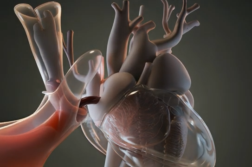
DR GILLESPIE: The Harmony Valve has two major components. One is the valve frame, and that frame is made of a series of metal zigs, which is a metal alloy called nitinol, and there’s six zigs stacked on top of each other that form the spine of the device. They’re all connected to each other by a polyester fabric. Into the middle of that, it looks like an hourglass, and into the middle of this hourglass, there would be leaflet tissue sewn in there, and it’s animal leaflet tissue, porcine valve leaflets. The device it looks big in its expanded state, but it’s designed to be elastic so that you can scrunch it down to a small size and push it in through a very small catheter. When it comes out of the catheter, it opens up. What keeps it in place is that it’s sized so that there is circumferential radial interference, so it’s an oversized fit in the targeted space. You go in and it’s oversized for the space that you’re putting it in. If we understand the anatomy appropriately and we’ve done our modeling appropriately, then you can predict that it’s going to be a secure fit.
Were there any special accommodations for Russell to be treated at the Children’s Hospital as an adult?
DR GILLESPIE: Yes. It’s really an issue because here, at Children’s Hospital Philadelphia, we treat adults all the time. The oldest patient I’ve treated here was 78 years old and the youngest patient I’ve treated here were newborns and we even do fetal therapies here. We have the ability to run the gamut. But Russell represents a patient population of adults with congenital heart disease, and that patient population is growing, largely because the therapies to treat congenital heart disease have been successful. So, Russell’s coming along at a time where we’re bridging the gap between children with the congenital heart disease, teenagers, all the way up into adulthood. We have an adult congenital heart disease program that follows these adults throughout their adult life to help with any issues that arise related to their underlying congenital heart defect, and that includes doing procedures in the cardiac catheterization lab. Most of the pulmonary valve procedures are done here at CHOP, but I also work next door at Penn in collaboration with the adult interventional team over there for the older and sometimes sicker patients.
Is there anything about Russell’s particular procedure or cardiac patients that you would want people to know?
DR GILLESPIE: To me, Russell is a very hopeful story. So, if there are parents out there and they hear their child’s being born with congenital heart disease, I would look at Russell’s story. He was born at a time when the therapies were nowhere near what we have now and look at what that man’s been able to do, look how successful and healthy he is. I also think that Russell, and patients like him, are willing to take risks. There’s no question about it that at the time we started doing these procedures, there were a lot of unknowns. To have the courage to trust me and our team that we were going to get him through this, I think that’s heroic.
END OF INTERVIEW
This information is intended for additional research purposes only. It is not to be used as a prescription or advice from Ivanhoe Broadcast News, Inc. or any medical professional interviewed. Ivanhoe Broadcast News, Inc. assumes no responsibility for the depth or accuracy of physician statements. Procedures or medicines apply to different people and medical factors; always consult your physician on medical matters.
If you would like more information, please contact:
Natalie Solimeo
Sign up for a free weekly e-mail on Medical Breakthroughs called First to Know by clicking here