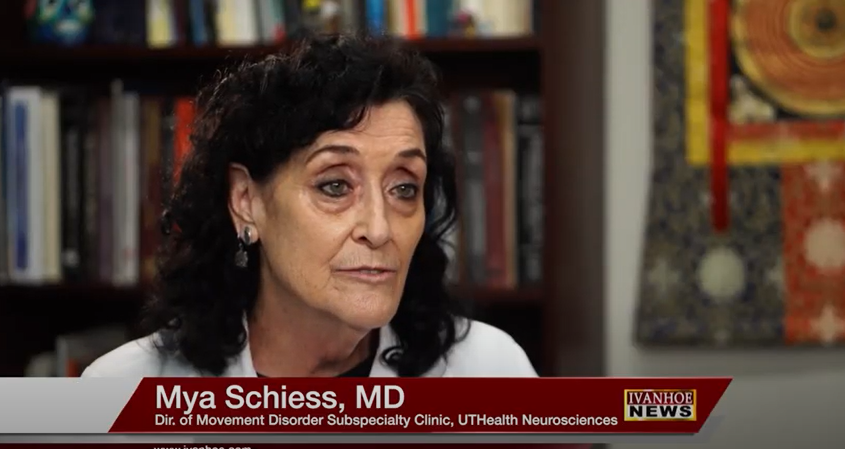
Mya Schiess, MD, Director and Creator of Movement Disorder Subspecialty Clinic, UTHealth Neurosciences, talks about Parkinson’s.
So, talk to me about your trial with stem cells on Parkinson’s?
SCHIESS: OK. Would you like to know about Parkinson’s disease first or just the trial?
If you give us a broad overview just on how common, it is.
SCHIESS: Parkinson’s disease is actually becoming more and more common. There’s an increase in the number of people affected worldwide. It’s actually thought to be the most rapidly growing neurological disorder. The best way to understand Parkinson’s disease is to understand that it affects motor systems. And it affects motor systems by causing unintended movements and, you know, a loss of dexterity (skill and ease in using the hands), et cetera. A very small percentage of people with Parkinson’s disease are actually inherited. Most of it is thought to be due to a combination of genetic susceptibility and an environmental trigger. It also affects individuals over a long part of their lifespan, actually earlier, when it’s not diagnosed, and then later, when it’s diagnosed in their 60s and 70s. It is the motor manifestations of the disease that lead to a clinical diagnosis. The motor disruption is due to a loss of dopamine, which is a neurochemical in the brain that functions to smooth out our movements, make them appropriately fast and smooth and give us our dexterity, et cetera. And what happens in Parkinson’s disease, the neurons that make dopamine die. They’re lost from the disease process. It’s also a chronic disease and it is progressive. It’s classified as neuro-degenerative, which means it changes over time and it gets worse over time. The problem we have is that it’s increasing in prevalence. So, there’s many, many more people that are going to be affected in the next decade or so with Parkinson’s disease.
What about treatment?
SCHIESS: We know why the movements are affected in Parkinson’s disease. And we’re very fortunate because it’s actually a very treatable disease. We have lots of formulations of dopamine that we can give back to people so that we can improve their motor function. The problem is that we don’t have any therapies that actually cure the disease or stop its progression, and that’s why the trial that we developed is so very, very important. Our phase one trial is the first of its kind done in the United States with FDA approval. And it is phase one, meaning that it looked at safety and tolerability of using adult donor mesenchymal stem cells to treat Parkinson’s disease. We designed a study that utilized and escalated doses of mesenchymal stem cells. And when I say adult donor, these cells were taken – were donated from a healthy volunteer. The cells came from bone marrow.. And what we did is we set up four doses of mesenchymal stem cells. They were passaged out – that’s the terminology – in an FDA approved lab that follows good clinical management practices. And we set up 1, 3, 6, and 10 million cells per kilogram of body weight to be given intravenously. We had five individuals per dose, so we had a total of 20 individuals with Parkinson’s disease that we treated. These individuals had mild to moderate disease that was very well-defined. The purpose of the trial was to show that this was safe and well-tolerated. And we followed individuals out for a full year after their infusion and what we found was very exciting. We showed that, regardless of the dose that we used, it was very well-tolerated, we did not have any serious adverse events, and there was no immune response that was initiated by the mesenchymal stem cell infusions. Additionally, we had some secondary outcomes that we were looking for, and we showed that the infusions were followed a year out by improvement in motor function for our patients, and specifically the greatest improvement was found in the highest dose that we delivered, which was 10 million cells per kilogram of body weight. We also found that there was some suggestion of a mechanism underlying this improvement. There was a reduction in inflammatory markers in the blood, because there’s a lot of evidence that in Parkinson’s disease you have a chronic inflammatory state, so the brain undergoes changes and, in a way, it’s damaged and it’s out of balance. It’s out of whack. There’s inflammation going on, and mesenchymal stem cells are thought to be immune modulatory, they modulate that response. They can reduce the inflammatory response; they can produce molecules that are helpful and that restore health to the brain environment. And so that’s why we chose them as a therapeutic treatment. We also found that there were other improvements after the treatment, improvements in quality of life, improvements in activities of daily living as demonstrated by your interview with one of our patients. I can give you other examples. But what this phase one trial did is it allowed us to identify that mesenchymal stem cells were safe, we identified the best dose to use, and so then we developed a phase two trial. And a phase two trial is very different. It looks at identifying effectiveness. We call it efficacy of this treatment intervention, but we had to do it in a different way. So, phase two allows you to set up a trial where you compare your treatment with a placebo group. Our phase two trial is already in the works. We started in March, recruiting individuals. It’s quite different. It is based on 45 individuals that will be treated, and there are three groups of treatment. We’re using the 10 million per kilogram of body weight mesenchymal stem cell infusions. And one arm is three infusions of cells that are four months apart, one arm is a placebo infusion followed by two separate cell infusions, and in a third arm or group patients will receive three placebo infusions. And we’re looking for improvement. After the last infusion, we’re following people out for a full year. This is a longer study and repeated infusions and we’re looking to see a sustained improvement in motor function. We have a lot of clinical rating scales that we can utilize that are recognized universally and validated. We will use those to show that there’s clinical improvement versus placebo. We have other clinical measures and other molecular measures that we’re using and imaging measures to try to get to a better understanding of the mechanism of action of these cells.
For the phase one trial, was it only one injection?
SCHIESS: Yes. There was a single injection and a single dose per group. And then, after the injection, we followed the subjects out for three, six, nine and 12 months and analyzed the data.
After the year, are you guys not pulling any more data from the phase one trial?
SCHIESS: Yes, we are. We have supplemental data that we’re analyzing. We found changes in cerebral perfusion (brain blood flow), we’re also trying to follow our patients up to see how well they’re doing, whether it’s a sustained response or not. Yes. And we’re doing more analysis in the what’s called peripheral markers of the disease to see how much they were affected by this single infusion treatment.
We talked to Marie and she’s, I believe, three years out from getting her injection and she still is…
SCHIESS: Feels like she had a turnaround in her disease process andthat’s the hope of this treatment. There’s tremendous potential in using mesenchymal stem cells and we’re thrilled with Marie. We have other people, but we have an individual who became withdrawn you know, from family and things that he usually participated in. And then, after his treatment, he’s camping, hunting, going on backpacking trips with his siblings and competing with them again. Wonderful stories and feedback that we’ve gotten from the single treatment, so we’re very, very encouraged that this phase two trial will show that this can be potentially a sustained effect. And we have a lot of treatments that address the symptoms of the disease, but this kind of treatment approach will actually halt the progression of the disease, which would be very powerful. Very meaningful for millions of people.
Phase one was one single dose, and so phase two, are you testing out multiple different doses?
SCHIESS: So, for phase two we’re studying three infusions with the same dose. And people will get either three cell infusions that are spaced apart or they will get two cell infusions and one placebo, or they will get three placebo infusions. You have to set up the phase two trials that way. There’s a structure for clinical trials that allow you to proceed from understanding the safety, tolerability, and then moving into effectiveness. And even with your phase two trial, of course, we will look for a detrimental immune response, any detrimental side effects or adverse events going on. But the whole purpose is we will have it compared to a placebo and we will do repeated infusions. And hopefully repeated infusions will have this effect of significantly improving motor function.
You said that you guys already started with phase two, are you still recruiting or are you done with recruiting, and you already have, like, maybe one- or two-months data already? Or where are you in phase two?
SCHIESS: In phase two, we are almost finished recruiting. In fact, we’ve identified our 45 individuals, but we are in the process of screening, enrolling. And we’ve already started our infusions, we have collected data and we are already analyzing it. And we’re about halfway through with our initial infusions. So, this is going to be a little bit longer study. It’ll probably be a two or three year study because when you get your final infusion, then you’re followed out for another year.
And with the phase one trial, what was the most surprising finding that you found in the results?
SCHIESS: The most surprising I think was that, a year out, there was statistically significant improvement in motor function as defined by a very specific scale that we use, the UPDRS motor subscale, and that there was also a sustained improvement in what’s called the total UPDRS score, which includes activities of daily living, quality of life measures, et cetera. These are two clinical measures for Parkinson’s disease patients, that encompass virtually everything that’s really affecting them and impacting their quality of life and their movements. So that was outstanding. And remember, this was a study that was really focusing on safety, and so we were very happy to see this improvement.
And just going back on the background on Parkinson’s, how can this disease impact people day-to-day?
SCHIESS: Well, the classic motor symptoms are ones of causing something that’s very visible, which is tremor. One thing that’s paramount and has to be included is the presence of slowness. We use the neurological term bradykinesia; it means slowness of movements. But that has a profound impact on people, meaning that it can takes twice as long to do things. And that’s just in the beginning of the disease. So when you get up in the morning, it might take me 30 minutes to get dressed, comb my hair, brush my teeth, put on a little makeup or, if I were a man, maybe shave, something like that, you know, 30 minutes. Well, when Parkinson’s hits, it takes an hour, an hour and a half, and then two hours. So, there’s a profound slowing of movements that we just take for granted. There’s a loss of dexterity. There’s also something called muscular rigidity, and a lay term for that would be stiffness. People feel stiffness. As a neurologist, what I see is, slowness of movements and muscles that are kind of rigid and don’t move. Things that one can do readily become harder and harder and slow and difficult to do. That’s what happens in Parkinson’s disease, and it’s all mediated by the loss of dopamine. And other things that can change is a person’s posture and their gait, how they move in space. It becomes much more stiff, rigid. And their posture changes, arms don’t swing, they become bent over, et cetera. These are all things that are actually due to this loss of dopamine functioning in specific areas in the brain.
And then after the phase one trial, the results that you got from it, have you seen it improve every single aspect of those symptoms?
SCHIESS: Absolutely, yes. I have to answer that by telling you that that’s what I mean by motor symptom improvements because that’s what those scales look at. They look at tremor, they look at muscular rigidity, they look at speed of movement, they look at the completeness of movement, the amplitude of the movement. And so those scales are telling us that all aspects of the motor symptoms have improved.
And was that for all patients?
SCHIESS: That’s a really good question. Yes. Now, I will have to say that it wasn’t sustained as well in the lower doses. So, the lower doses had an improvement initially, but it wasn’t sustained as well, and it wasn’t significantly sustained as well as the final and largest dose.
In the phase two trial, is there any results that you’ve seen so far?
SCHIESS: No, because we just started everything, and we will have our initial follow-up where we look at individuals in August.
And I know we heard from Marie but what has been your feedback so far from most patients?
SCHIESS: Oh, I feel bad about this, but the fact that everybody that participated wanted to participate in phase two. So, we were very, very fortunate, everybody that participated has given us very positive feedback. There has not been any negative feedback. And also, the desire to participate in phase two. Unfortunately, when people receive stem cells you can’t go on to phase two and allow the participation because it changes their baseline. It was a very positive response to phase one and everybody wanted to participate. But anyway, having said that, you know, we’ll try our best to think about having them participate possibly in a phase three trial or something of that nature.
When someone is first diagnosed with Parkinson’s, how long does it take to get to that point where it’s severely impacting their everyday?
SCHIESS: Right. So, there are stages of Parkinson’s disease, and you can look at it as five stages or, in a simple manner, you can look at it as mild, moderate and severe. The time it takes to get too severe, where their gait is dramatically impacted and maybe their cognitive function is somewhat impacted, their ability to swallow well could be dramatically impacted, those are kind of the hallmarks of severe Parkinson’s disease. It takes a good 20 years after your diagnosis. In the early part of Parkinson’s disease you don’t really see it in their movements. You see it in disruptions of sleep where you get a very unique sleep pattern where people can act out their dream content. You see changes in a person’s GI function, gastrointestinal function. Severe problems with constipation will occur. You can have problems with loss of sense of smell. You can have problems with anxiety and depression that weren’t part of their emotional state before the onset of Parkinson’s. And then, by the time the disease is diagnosed, because you manifest motor symptoms, you’re actually well into the disease process.. What you want is to have physicians that know how to treat the disease and set up a good medical regimen. Even deep brain stimulation is quite effective, so medical, surgical interventions, physical therapies, are quite effective. You know, being physically active is very therapeutic in Parkinson’s disease. It helps with both your physical well-being, your motor function, and your cognitive well-being. People can live very well with Parkinson’s disease with an optimized medical, surgical, physical therapy regimen, good lifestyle changes, improving diet, getting good sleep, et cetera. But we don’t have anything that really alters the progression of the disease, and that’s why this trial is so important. It gives us hope that we can alter the progression of the disease, otherwise it’s relentlessly progressive. And so, we really want that ability. That treatment, that kind of stops the disease progress. So, we think inflammation in the immune system has a lot to do with driving the degenerative process in Parkinson’s disease. If we can stop that process and restore health to the brain and maybe even save some neurons from dying with this treatment, then it’ll be very powerful.
For the people that are in phase one, I know Marie is looking for the next injection, if the results from phase two are very positive, will those people that took part in phase one, will they have the opportunity to possibly get another injection?
SCHIESS: That’s a really good question. It’s very hard for me to answer it. We asked if we could enroll them in phase two and the answer was no. This is from the FDA and our IRB. Which is fine. It’s actually understandable. The way we set up the next phase, if everything goes smoothly, if we have a good result in this phase two and if it’s safe, et cetera, then the way we set up phase three, we may be able to have a way to allow them to get a second treatment.
INTERVIEWER: I do have a question, why, in one of the arms, are you doing a placebo and then two doses? I’m just curious.
SCHIESS: Yes. It is interesting.. This is really more of a protocol answer. What it will do is it will give us information, more information about individuals. It will give us information about whether two doses are sufficient to have the same outcome as three doses, which, you know, when I say that, it doesn’t sound terribly compelling to set it up that way. But it also allowed us to regulate the time between doses because that might be a powerful mechanism that we need to look at. Let me explain that a little more. So, the interval between doses is four months. And what we saw in phase one was initially, their response to the infusions was profound at three months but, by six months, we saw a tick up to what baseline would be. So, there was a gradual return to baseline. Now, in the highest doses, it never returned to baseline, and that showed this improvement, right? But what we don’t know is the time interval and whether it just takes two doses and whether this four-month interval is sufficient and whether, again, two infusions or three infusions really plateau so that there’s no return to baseline and the improvement is sustained. Does that make sense? Yeah, so that’s a very good question.
Interview conducted by Ivanhoe Broadcast News.
END OF INTERVIEW
This information is intended for additional research purposes only. It is not to be used as a prescription or advice from Ivanhoe Broadcast News, Inc. or any medical professional interviewed. Ivanhoe Broadcast News, Inc. assumes no responsibility for the depth or accuracy of physician statements. Procedures or medicines apply to different people and medical factors; always consult your physician on medical matters.
If you would like more information, please contact:
DEBORAH MANN LAKE
Sign up for a free weekly e-mail on Medical Breakthroughs called First to Know by clicking here