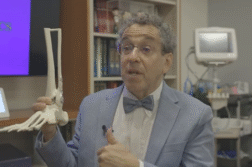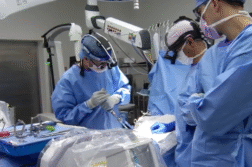
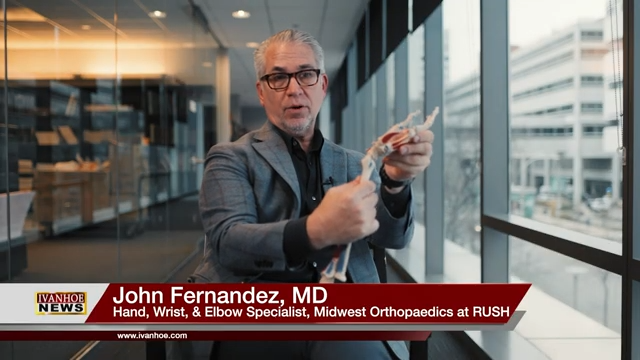
John Fernandez, MD, Hand, Wrist & Elbow Specialist at Midwest Orthopaedics at RUSH talks about a new way to perform wrist replacement surgery that doesn’t require rehab.
Interview conducted by Ivanhoe Broadcast News in 2024.
What sets wrist arthroplasty apart from traditional treatments for arthritis and how it addresses the limitations of fusion?
Fernandez: So arthroplasty is just the generic term that we use for a reconstruction of the wrist. Arthroplasty can basically describe almost anything where you’re basically changing the anatomy, the shape, and in some ways the function of the wrist. The way that a lot of people use the term arthroplasty would be replacement. And so knee replacement, hip replacements, people will use the term knee arthroplasty or hip arthroplasty. In the wrist, there’s a lot more options other than just a total joint replacement. Total joint replacement is where you’re removing the native tissue, the bone, and the cartilage and you’re replacing it with an actual implant- you’re replacing it with metal or plastic or carbon. And arthroplasty, though, is much more generic. It includes joint replacement, but arthroplasty also includes things like, resurfacing where you’re using biologic materials to create new cartilage and things of that nature. Arthroplasty doesn’t necessarily always mean wrist replacement. So there is a little bit of a distinction between the two. But in the wrist in particular, because wrist replacement is relatively new compared to knee and hip replacement and the results always haven’t been as good as they are more recently with the newer implants. Arthroplasty has been a more complicated subject for the wrist, until more recently with the newer implants that we have now.
How does it compare to fusion?
Fernandez: So the fusion is where you’re actually welding the joint. So imagine the difference between a knee and a wrist. The wrist can actually tolerate a loss in motion. Because your wrist- yes, you need a wrist to move back and forth to function normally. But what you really need for the wrist to be is stable. The wrist is basically the platform for your hand for you to open and close your fingers. The elbow and the shoulder are much more important in terms of mobility. But imagine most of the things that we could do, we could probably do it with our wrist locked in a neutral position and that would be a fusion. Fusions are nice because they’re bulletproof, they last forever, they’re very reliable at taking care of pain, and they have a low complication rate, but they leave you with no motion. And so in some patients, that’s non negotiable, or in patients who have bilateral disease, that would even be more disabling. So wrist fusion is very different than a wrist arthroplasty, because a wrist arthroplasty preserves mobility. It allows you to still move the wrist and hopefully it also then takes away or mitigates pain.
What results have you observed in patients who have had a wrist replacement and how has it impacted their quality of life?
Fernandez: So wrist replacement, there’s two types. We think about the wrist is divided into two joints. There’s the joint that moves the wrist into extension inflection or back and forth, and then there’s the joint that moves the wrist into supination palm up and pronation palm down. Wrist replacements have been very difficult to figure out because it’s not like you can shrink down the implant in a knee and a hip and get the same results. The results with hip and knee replacements for most people have been phenomenal. Excellent results- long term excellent results in terms of durability, low revision rates, low complication rates. The wrist hasn’t enjoyed that same success, especially with regards to extension inflection. The complication rates are higher risk of infection, higher risk of the implant loosening. And so we’ve been more gun shy about using those in, let’s say, younger patients or in all patients. So the indications for wrist replacement surgery are much more limited. They’re much more narrow. You need a patient.
Yes, who is the ideal patient?
Fernandez: The ideal patient would be somebody who has bilateral wrist disease. Because now they can’t afford to have one wrist that’s fused or both wrists that are fused. It’s a patient who is still active, but at the same time, lower demand. So we’re not talking about a patient who’s in a nursing home and we’re also not talking about a patient who’s working a heavy job or playing heavy recreational sports. So there’s still a lot of people who fit that category.
Who is not a good candidate for wrist replacement?
Fernandez: Younger patients, patients who have higher physical demands, whether they’re recreational or job related because they will basically wear out the implant or the implant will fail prematurely. So again and those indications are different than they are for a knee or a hip, where in a knee or a hip, you can do those in young patients. You can do those in patients who have a high physical demand level. You can do those unilaterally in patients. It’s not to say that you can’t do those in the risk, but you have to be much pickier because the stakes are higher, the risk is higher. The results are still excellent if you pick that correct patient.
You are one of the few that’s really doing this nationwide and I know this technology is fairly new. What was the moment? Why all of a sudden now are you like, ‘I am going to start doing this in patients’?
Fernandez: Well, what changed was the implant itself. In other words, the implant that now we use for this specific type of replacement has changed. There have been other versions of the implant. And just like a lot of innovations, the first iterations, think back to Kitty Hawk and the first version of an airplane to the version of now, an F16 fighter jet. They’re both planes. They both fly, but they’re clearly different. So the implants have undergone generational changes, so that’s changed. The technology has changed in terms of the materials that we use. So it’s a combination of engineering, changing the way we make the implant, the type of implant, or the material. And then the innovations of surgeons using it and trying to figure out the best mouse trap or the best way to put the implant in.
Tell me about osteoarthritis.
Fernandez: Well, any arthritis, whether it’s osteoarthritis from aging, rheumatoid arthritis from inflammatory arthritis or post traumatic arthritis from trauma. But what really changed was for the distal radioulnar joint. That’s basically half the joint in the wrist. And for many years, we have not been able to figure out the correct implant for that. They’ve come and gone. They’re on the market for a few years. They get withdrawn because of the complication in the failure rate. And these are in young patients. So this isn’t a younger group and it is very disabling because it affects the ability to turn the hand. So when the implant came out that really seemed to solve the problem, I got to be honest, initially for the first few years. I was a little bit shy about using it and reedicent about using it. And then when we started using it, we saw and we were able to duplicate the results that other people were reporting on and it’s just blown us away. I mean, it’s really one of the few things that’s revolutionized the treatment of the wrist in probably the last 15 years.
Pick up that skeleton there for me and show me what you would do if this was my wrist and I needed wrist arthroplasty? What are you moving around or taking?
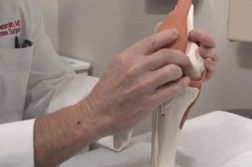
Fernandez: So the wrist joint is composed of the radiocarpal joint, which is the wrist that goes back and forth. But people don’t realize that the other half of the joint is this joint. That’s the joint that allows you to go palm up like you’re wiping your bottom or palm down, when you’re reaching on a surface like a desk. And that part of the wrist joint is this one right in here, and that has been a very problematic joint. And up until recently, the way we would treat this is we would remove that bone and literally throw it away. And then we would pray that the connection between these two bones would be restored. But it really would never be truly restored. There would always be a loosenss there that wasn’t present before. And that would lead to pain, what we call crepidus, which is a noise and pain and weakness. And so that connection was never really fully restored. What the implant does, it literally does what this model is doing. What we do with the implant is we remove the very end of the bone, we replace it with a metal implant that looks like that bone and it has a long metal stem that goes on the inside of the bone. The bone is hollow on the inside. So it has a stem that fits in there. And then there’s a plate on the side of that that captures that. There’s a little ball that goes on the end of that implant, and it basically captures that little plastic ball. So now what happens is when the wrist rotates, it’s rotating around that little ball and it’s captured by that metal implant on the side. So it’s extremely effective at recreating that connection, like a hinge. It’s like putting the hinge back on the door, so now the door can open properly. And what’s most remarkable is you see these patients, two weeks later, they have no pain. And these are patients who have been in pain for literally 20 years. They’ve had five or six failed surgeries. They’ve had the conventional surgeries, injections, et cetera and they come back two weeks later and it’s almost emotional. Some of these patients break down and cry because they can’t believe how well they’re doing. They can finally move their wrist in a normal way. And even almost most importantly, is that it’s not at the expense of significant, high complication rate of infection or loosening or loss of the implant.
How long are you out for? Two weeks?
Fernandez: You would think it would be with something that’s this high tech that there would be a lot of rehab involved. There’s not because you haven’t touched the muscles. You haven’t touched the tendons, you’re waiting for the soft tissues to heal the skin, et cetera. But you don’t have to rehab anything because you’re not waiting for a ligament to heal. You’re not waiting for something to glue together like a bone. So when these patients come in and they can move it two weeks and they’re asking the same questions. They’re like, well, how many months that we have or therapy? And you tell them, you don’t need any. You basically can start using the hand in the wrist. We do tell them, we don’t want you to do anything overly heavy only because we want to preserve the durability of the implant. So we tell people limit your weight under 20 or 30 pounds. But we let them play Pico ball, we let them go back to golfing. We let them do light chores, et cetera. And that’s really what most of us want to do. We want to be able to live an active lifestyle. We don’t necessarily have to go back to lifting heavy weights or using heavy tools. And that’s what’s so revolutionary is that it takes away their pain, it preserves their motion, and it gives them their strength back.
What’s the next gen?
Fernandez: The next gen would be to solve the other joint- the other part of the joint which is the radiocarpal joint. Because this one, I don’t- obviously, we’re always trying to improve it. We want something that’s going to last forever, that has a zero complication rate. That’s obviously always our goal. And with this implant, we’re close. I mean, you’re talking about 95 percent success rate in terms of preserving the implant for at least 10 years, less than five percent risk of removing the implant, having an implant infection or some type of implant failure.
What is this component of the wrist called?
Fernandez: It’s called the distal radioulnar joint.
Can you describe one patient that you’ve performed the surgery on and what was the pre and post, and maybe what did they get back to?
Fernandez: The one that was really impressive was a police officer, and it was- for her, being a police officer was for me being a doctor. It was not a job. It was like your calling. It was like, if you didn’t pay me, this is what I would do. And that was her passion. And so I really identified with that with her. And one of the things that she really missed, because of her injury to the wrist and it was a work injury was people were telling her she couldn’t be a police officer anymore. And so that really was hard on her. And at the same time, she was bringing up a young family. So here she is. She’s a working mother. She’s trying to raise a family. She’s still trying to make an income, but also trying to do something that she’s passionate about. And she had a pretty bad injury to the wrist and she had several failed attempts. And the big problem for her was pain. The pain was just very difficult to control. She had been in pain management, medication, injections, et cetera. And so we proposed this to her because we were basically at the end of he rope. She was one of the first patients that we did this surgery on. And she was the one that convinced me that this is really revolutionary. And when we did the implant, again, it was one of those emotional moments where two weeks, she’s like, I’ve been in pain for 15 years and I finally don’t have that pain anymore. And I finally feel like there’s a light at the end of the tunnel where I might be able to go back to work, and go back to a more normal life.
Did she go back to work?
Fernandez: She did go back to work. She went back to being a police officer. No, I think she named one of her cats, John. That might be true.
END OF INTERVIEW
This information is intended for additional research purposes only. It is not to be used as a prescription or advice from Ivanhoe Broadcast News, Inc. or any medical professional interviewed. Ivanhoe Broadcast News, Inc. assumes no responsibility for the depth or accuracy of physician statements. Procedures or medicines apply to different people and medical factors; always consult your physician on medical matters.
If you would like more information, please contact:
Ann Pitcher
Sign up for a free weekly e-mail on Medical Breakthroughs called First to Know by clicking here