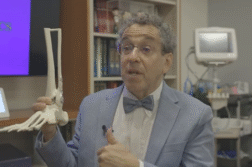

Karl Zelik, PhD, Assistant Professor of Mechanical Engineering at Vanderbilt University talks about back pain and smart underwear.
Interview conducted by Ivanhoe Broadcast News in December 2018.
Where did the idea of this smart underwear come from?
Dr. Zelik: Smart underwear came about largely because of my son. He’s three years old now. He insists on getting bigger, and he’s frankly destroying my back from all the lifting and carrying that I do with him. So I started thinking about whether there was some kind of wearable assistive technology that I could use in my daily life — technology which ideally would fit underneath my clothing so it was not visible, so that it was not obtrusive or getting in the way of me sitting down, or playing on the ground with my kids, or doing all sorts of other activities, like getting in and out of cars. I looked around at what was on the market. There’s exoskeletons that are being developed which have large rigid frames that might be good for some industry jobs. There are soft robotic exosuits that are being developed with backpack motors. There are spring-loaded devices which have mechanical frames that fit around my body. But I just didn’t find anything that I felt would work for me. So I started thinking about whether there was some kind of biomechanical solution, whether I could embed fabric springs in certain ways within my clothing and if those springs could be engaged when I needed them to help offload my back. And that’s what led to this trajectory of research surrounding smart and assistive clothing, or what we often refer to as smart underwear!
What does this clothing consist of, what’s the science behind the material helping you prevent back pain?
Dr. Zelik: The basic idea is that when you lift up an object — whether it’s your child, or a box, or anything else — there’s some amount of force that’s transferred from that object down your body through your spine and so it loads your low back. However, the reason that you don’t fall forward on your face is because your lower back muscles are contracting really hard to prevent you from pitching over and falling forward. If you actually were to put a sensor down inside your spine you would measure that the majority of the spine loading is self-inflicted: it comes from your own back muscles contracting. So instead of all of the force going through your back muscles, what you can do is you can run an elastic structure, basically a fabric spring from your shoulders down along your backside over your butt and attach it to your thighs. And when you lean forward or when you lift something up, then some of the force goes through the elastic band as it stretches, and the force doesn’t go through your muscles. This helps offload your low back.
I know it’s supposed to help prevent back pain so it’s not for treatment of back pain, but if somebody had a little bit of back pain would it help them at all? Who would you say this would be best for?
Dr. Zelik: Right now we’re really focused on prevention, as you said. If you work in a job where you’re doing a lot of repetitive lifting, or a lot of prolonged leaning, then you put a lot of stress on your back. Again it’s mostly from your own muscles contracting. As a result, it’s fatiguing, it’s difficult and there’s a lot of wear and tear on your body. So the idea is to help you if you’re in one of these positions where you are already at heightened risk for developing low back pain. You can think about nurses, package handlers, caregivers, construction workers, and the list goes on and on. So for these folks, if we could integrate some sort of assistance in to their clothing we could relieve some of that stress and some of that pressure off of their back. At this time we’re focused on prevention, rather than treatment of back pain with this type of device, but that’s something we would like to explore and consider in the future.
How far down the line do you think this will be available, that people can actually purchase for themselves?
Dr. Zelik: We’re exploring a few different versions of this technology. One version is what I refer to as assistive clothing, or assistive underwear. This version is relatively simple; we’re not embedding a whole lot of sensors, and there’s not necessarily motors. So we’re working to commercialize this version in the next couple of years. With some more advanced versions of this technology, we’re introducing sensors and machine intelligence into to your clothing. Imagine if you had a super hero sidekick, that goes with you throughout your day, stays out of your way, watches your back and then in moments when you need it, it leaps in to action and helps you! In these cases, if we can introduce sensors into the clothing so they can monitor the stress on your body, for instance on your back, and we can allow machine learning algorithms to use the sensor data to figure out when to assist you, then the clothing could almost be this kind of autonomous sidekick that helps you out when you need it and stays out of your way when it’s not needed!
Can you talk a little bit about the testing that you’ve done on this clothing?
Dr. Zelik: Sure. When we first came up with this idea of introducing these elastic elements into clothing, to determine whether we could actually offload different parts of your body, in this case your low back, we brought subjects into the laboratory. We built a prototype and we used our specially-equipped lab — which has cameras, force-sensing floor tiles and muscle activity sensors — to measure how much assistance the device was providing to people. We put small electrodes that measure muscle activity directly over the subjects’ low back muscles and then we had them do a lifting activity, repeated lifting, and then we had them do prolonged leaning, where they just held a posture in different positions. What we found is that the back muscle activity, which is an indication of how much force is being generated by those back muscles, was reduced anywhere from about twenty to forty percent, on average.
That’s a lot.
Dr. Zelik: The smart underwear are not going to do the task for you. They are going to help offload your musculoskeletal system to help prevent fatigue, to help reduce your risk of injury and basically keep you fresh and productive for a longer period of time.
The suit that we’re going to see later, walk me through the process, if somebody has it on what do they do? How do they get it to work what’s the step process?
Dr: Zelik: Okay. There’s two versions of the suit. The first version that we currently have built, well, you can think of as assistive clothing. So, if you are going about your day — for instance I’m sitting here so I don’t need assistance from my clothing — then the device would be disengaged. Nothing would be happening. No spring assistance. My clothes would just feel like regular clothes. If I had to walk across the room and do some sort of heavy lifting task, then I would either tap my clothes or tap my smart phone, or maybe even use voice control in order to activate the springs within my clothing. And then when I bend down to pick up the object, instead of all of the force going through my back muscles, some of the force would actually be transmitted through my clothing. As soon as I’m done with my lifting task I tap my clothes again, or my smart phone, and it disengages. I then go about my daily life, in what feels like normal clothes.
I’m very fascinated by this idea of everyday superheroes… like my wife. Right now she is at home with our two little kids (one and three years old). She’s got a lot on her plate. It’s not easy. And it’s really exciting for me to think about whether we could design some sort of clothing, some sort of garment, that would help offload a little bit of the stress from her daily life. If we were to go across the street from this building, then we have the Veterans Hospital, we have the Vanderbilt Medical Center — how many thousands of nurses are there – and across the globe – lifting, leaning and carrying in order to care for patients? These nurses are also heroes. And how many of these heroes are going to develop back pain within the next year? Can we develop something that would make their job a little bit easier; something that would activate when they need it to offload some of the stress that is happening along their back. Similar types of smart clothing could be developed to help with their arms for carrying. Or if you’re a surgeon or dentist who has to lean over for long periods of time, a similar smart clothing device could be designed to help support your neck. So that’s the idea… how can we introduce these super suits into daily life in a way that’s not interfering with your daily tasks, it’s fully concealable underneath your clothing, there are no large motors, there’s no big metal components, its comfortable and there’s nothing that prevents you from doing what you need to do. Yet, device assistance is available to you when you need it. So smart underwear is not going to help you all the time, and it’s not going to do the task for you. If we help you too much we’re not doing you a favor; that could actually de-condition your fitness. So the idea is to only assist you when you need it to help reduce your risk of injury, your risk of pain and reduce the fatigue associated with certain physically-demanding jobs.
What’s the second version, the process for the second version?
Dr, Zelik: The first version is really an assistive device where you are the driver and you tap your clothes in order to engage or disengage the device. You decide when you need assistance. The second version of the device is one where we combine exoskeletons, smart watches, machine learning, biomechanical science and clothing. The idea is that we introduce some sensing ability and some intelligence into your clothing. Your clothing will monitor the force on certain parts of your body, say your low back. If it notices that you are overloading your back, or you’re overexerting your muscles, then the smart clothing engages to help offload your back, but just during those times when you need it. And your smart clothing then suggests to you maybe you should take a rest if you’re overdoing it.
If you’re going to do something you engage the clothing and then you’re done but you forget to disengage it, does anything happen?
Dr. Zelik: If you were to forget to disengage the device it is really just a spring that’s running along your back. If you were to then move in certain ways you may feel a little bit of resistance that’s pulling you in the other direction. That would likely remind you that you wanted to disengage it. Then you would simply tap and your clothes, and they would go back to feeling like regular clothes. At that point you’ll have your full range of motion, so it’s not going to inhibit you from moving in any direction when its disengaged.
If you forget to disengage it would be a noticeable feeling?
Dr. Zelik: The way that I would describe this is: imagine you had to lean over a table and perform some activity for a long period of time. It would start becoming very tiring and stressful on your lower back. Imagine if someone came up behind you and kind of took you by the shoulders and just provided a little bit of support. That’s essentially what this clothing is doing. It’s just helping you to perform the task. If you were to lean over and forget to disengage it you would just have that little bit of assistance as you go about doing other tasks. The reason you can engage and disengage the spring is because we don’t think you need assistance one hundred percent of your day for everything you do. The idea would be to selectively engage assistance to help you during times when you’re doing either a long leaning task or a repetitive lifting task, or some other strenuous activity in which you need help.
And the next version you’re working on is one that’s automatic?
Dr. Zelik: In the next version, instead of you deciding “I’m going to lift this object and I need assistance,” the idea is that the clothing would be monitoring the stresses on your body and it would decide when to assist you. Sensor data would allow your clothes to determine: okay this person doesn’t typically do this amount of lifting, they are exceeding what they typically do in a given day or a given week, so we are going to activate the springs, and we’re going to assist this person such that they don’t overuse or wear out their back.
What’s next for this, is there any other areas that you’re looking at outside of this clothing?
Dr. Zelik: There’s three really exciting things happening. One is in the short term, we are working on commercializing the assistive version of the clothing. This is the version without the sensors, and without machine intelligence. So this would be a lower-cost, manually engage-disengage version of smart clothing to help individuals such as package handlers or nurses. We are working to bring this device to market and will be testing it in the field with industry partners this year. The second thing is that we just received a grant from the National Institutes of Health in order to make the smart underwear truly smart; by adding in sensors, and machine learning. We have an expert here at Vanderbilt in wearable robotics, my own expertise is in biomechanics, and we have an expert in machine learning — we’re going to come together around the shared vision of creating truly smart clothing. And then the third exciting thing is assisting other parts of the body. Right now we’re focused on reducing societal incidence of low back pain, as this is one of the leading causes of missed work and physical disability. But the same approach to smart clothing could also be used to help someone’s arm during lifting, or perhaps to help say a patient after stroke who has calf muscle weakness, or to help a surgeon or a dentist who is leaning over for long periods of time to support their neck and avoid neck injury or pain. We’re very excited about applying the same sorts of technology to other patient populations, to other occupations, and to other parts of the body.
What do you think this will mean for someone in their job knowing that they have something that could protect them from possibly being disabled and losing their job or not even being able to work?
Dr. Zelik: If you look at the statistics it’s something like eighty percent of all adults are going to develop back pain at some point in time. If you have developed back pain before then you understand how it feels and how it affects your daily life; every aspect of your daily life: your quality of life, your likelihood of getting up and doing things you enjoy, whether it’s playing with your kids, being physically active, going out or socializing. I think for anyone who has experienced the pain, discomfort, and disability associated with low back pain, then the idea of not having to go through that again is extremely appealing.
Is there anything else you would like to add or you think that people should know?
Dr. Zelik: The one other thing that I would add is that the transformation of clothing that we’re talking about is similar to the transformation of wrist watches. Watches have transformed from time pieces into wearable devices that can actually monitor your physical activity and wellbeing. The idea with clothing is that we can add assistive capabilities, elastic structures into your clothing that can be engaged and disengaged, and we can add sensors and machine learning into your clothing, such that it can make decisions about when you need assistance versus when you don’t need assistance. What’s really exciting about smart clothing is that we now have the entire body to measure signals from, to monitor different localized parts of your body, and we have ways to physically assist you which is something that the smartwatches can’t do. We can actually engage spring-like fabrics inside your clothes to offload your body and keep you healthy and happy.
END OF INTERVIEW
This information is intended for additional research purposes only. It is not to be used as a prescription or advice from Ivanhoe Broadcast News, Inc. or any medical professional interviewed. Ivanhoe Broadcast News, Inc. assumes no responsibility for the depth or accuracy of physician statements. Procedures or medicines apply to different people and medical factors; always consult your physician on medical matters.
If you would like more information, please contact:
Heidi Hall, Media Relations
615-322-6397
Sign up for a free weekly e-mail on Medical Breakthroughs called First to Know by clicking here.