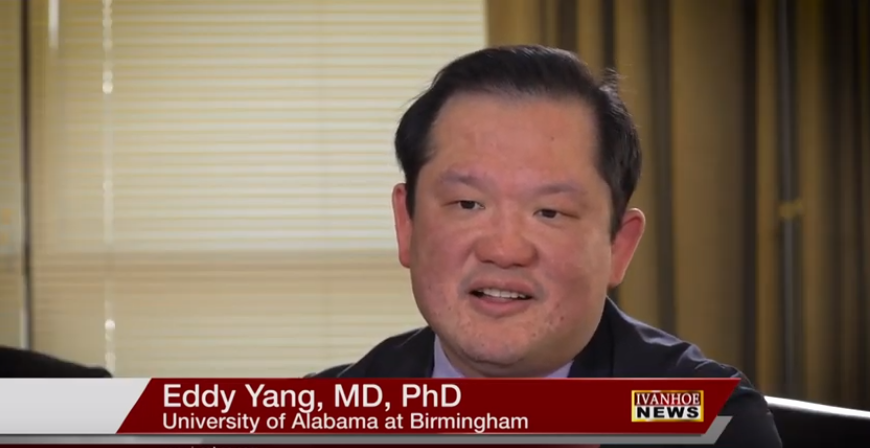
Eddy Yang, MD, PhD, Associate Director of Precision Oncology, Professor of Radiation Oncology at the University of Alabama at Birmingham talks about precision oncology and how it is helping patients.
Interview conducted by Ivanhoe Broadcast News in January 2019.
What exactly is precision oncology?
EDDY YANG: Precision oncology for us means to gather as much data about a patient and their cancer and trying to figure out what the best treatment for them is. Right now, everyone equates precision medicine or precision oncology with sequencing, but I think it encompasses a lot more than that.
How often is it used?
EDDY YANG: There are certain cancer types where it is used as part of standard treatment algorithms. For instance, lung cancer, melanoma, colorectal cancer. The molecular profiling for those cancer types are already being done as part of standard care. What we’re doing is also testing other cancer types, looking at the molecular markers and not necessarily treating the patients by their cancer but rather by what’s driving the cancer. This is typically for patients that have run out of options and where there’s no other standard treatments available.
It wouldn’t necessarily be like a first line of defense.
EDDY YANG: Not at this point. But we’re thinking about ways to gather enough data to show that it could improve the outcomes if we move it closer up front.
Could you go into the science a little bit? How do you find and match a particular drug that would respond to their tumor?
EDDY YANG: We can profile the patient’s tumor through a process called Next Generation Sequencing, where a lot of the targets for which there are drugs for are sequenced. If we find that a patient’s tumor has that particular mutation for which there is a drug against, then we put them on a study using that drug. At this point we have basket trials which are like arms of treatments that patients can go under; not necessarily based on the tumor type but based on their mutation profile.
You take a biopsy of their tumor?
EDDY YANG: That’s correct. With the other emerging technology, we can profile using their blood if there’s no tumor available. Or, if it’s too dangerous to undergo a biopsy, there are tumor cells that get shed into the bloodstream; they isolate the DNA from the blood that’s coming from the cancer and sequence the DNA from that perspective, which can find the same alterations.
What do you think the future holds in terms of treatments for patients or in the medical world in general?
EDDY YANG: If you think about target therapies, they have a specific target in mind and we’re better able to select patients for particular treatments. Now, equate that if you look back at prior trials where they didn’t select for particular patients that would respond better, those trials were negative. However, as the trial design improved, where they started looking at biomarkers, more trials became positive because they were able to select the patient population that were more likely to benefit. I think this type of effort is where we can select the best patients for the best drugs.
What other type of disease are using precision medicine for?
EDDY YANG: I think there is an area called pharmacogenomics where everyone metabolizes drugs differently. Looking at how a patient can metabolize a drug differently tells us that one drug is better than another for that particular patient, because they’re metabolizing the drug differently. The other areas include neurosciences. I think all of these studies are in progress and we are trying to figure out whether there are specific genes for Alzheimer’s, or Parkinson’s.
What are the advantages of using precision medicine to treat patients over other forms of treatment?
EDDY YANG: The advantages of using this precision medicine approach is that we don’t have to subject patients to therapies that aren’t going to work and that are going to be accompanied by the potential side effects. If you think about chemotherapy where it’s nonspecific, it could lead to hospitalizations and other health care resource utilization that may be avoided if we use a more targeted treatment approach that we know will have more likelihood of working.
Do you have success rates?
EDDY YANG: Yes. Speaking strictly with the patients that go on studies and also based on the literature that is currently ongoing, about 10 to 20 percent of patients are benefiting from this type of effort. It’s not a home run yet, because we still have to have a lot more research to do to better refine the patient and drug selection. However, there are instances like the RET inhibitors where success rates are higher. I think here, at our institution, we are trying to incorporate other data including patient clinical data, ethnicity, weight, what’s called a body mass index – BMI – blood pressure, and other information like that that we can we incorporate to better understand why one patient versus another, with the exact same tumor type and exact same mutation, respond differently to a drug.
Could you talk about Mickey’s case?
EDDY YANG: Mickey’s had prostate cancer. He underwent the standard treatments, including radiation and hormone therapy, but unfortunately the cancer came back, and he went through several other lines of treatment with the medical oncologist. At this point we knew we could profile the tumor, so we sent his old tumor, which I believe was from back in 2007, and we profiled it. It showed some alterations, but nothing that we could target. Then I mentioned the bloodwork that we could utilize to look for any mutations, so we sent the blood out to profile it and we found the alteration that is commonly seen in familial ovarian cancer and breast cancer; for which there is a very good class of drugs called PARP inhibitors. He matched to that drug and has been doing really well. I believe he has been in remission for over a year now. This is a patient who had no other lines of treatment after he had exhausted all the standard treatments. His case is interesting because, prior to coming to us, he was thinking about going to another institution but then he heard that we were doing a similar effort and he came to us.
Did it surprise you that ovarian cancer drugs were able to help him?
EDDY YANG: No, it didn’t surprise me because at the time some data had been published about using this class of compounds in prostate cancer patients with that alteration. Some preliminary results were reported using the PARP inhibitors for patients with prostate cancer. However, I think this goes to show that we’re now looking at the root cause of cancer and not treating patients based off of their cancer type or where the cancer is located; we are looking into what the root cause of the cancer is and treating it based on that.
How do you believe that using precision medicine improved the quality of life for Mickey?
EDDY YANG: I think it improved his quality of life dramatically because this is a well-tolerated treatment. He said within a few days of starting that treatment he was able to mow his lawn and go back to work. I think it’s it’s been a nice result for him.
The tumor that he had cannot be operated on, right?
EDDY YANG: That’s right, there’s no surgical intervention possible because he has had many other treatments and it’s metastasized.
Is there anything else you think people should know?
EDDY YANG: We really need to understand cancer better. I think we’re on our way to doing that with this precision oncology effort and it’s important that we get as much data about a patient as possible; this is where I think informatics will become important. You hear about artificial intelligence efforts about all of this. I want to make sure we temper expectations currently because it is not a home run at this point for all cancer types. There are specific tumor types that this is useful for but we’re learning more about it.
END OF INTERVIEW
This information is intended for additional research purposes only. It is not to be used as a prescription or advice from Ivanhoe Broadcast News, Inc. or any medical professional interviewed. Ivanhoe Broadcast News, Inc. assumes no responsibility for the depth or accuracy of physician statements. Procedures or medicines apply to different people and medical factors; always consult your physician on medical matters.
If you would like more information, please contact:
Bob Shephard, Media Relations
Sign up for a free weekly e-mail on Medical Breakthroughs called First to Know by clicking here