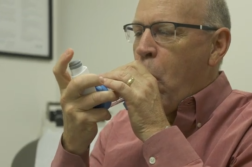

Doctors Jeffrey Ewig, MD, a pediatric pulmonologist, and Priya Patel, MD, assistant professor in clinical medicine and allergist and immunologist at the University of Pennsylvania and Children’s Hospital of Philadelphia, talk about a new treatment designed to provide relief for children with asthma AND bad allergies.
Interview conducted by Ivanhoe Broadcast News in January 2022.
What’s going on with a child who’s struggling with asthma?
DR EWIG: There are a couple of things going on. Patients with asthma have a variable timing of the airways that changes over time and is related to various triggers that they might have. They might be triggered by viral illnesses, sometimes they’ll have trouble sleeping at night. Activity is a big trigger and allergies are a big trigger, as well.
DR PATEL: It can be a variety of triggers. There can be indoor allergens, like our furry friends at home – dogs, cats, hamsters, guinea pigs. Mold can also be an indoor trigger. Or it could be an outdoor trigger, so, various pollens – tree pollen and grass ragweed – various outdoor molds, as well. It really depends on the patient. Some patients are sensitized more to outdoor pollen, some patients are sensitized to both.
Do some pediatric patients just have asthma and it’s not exacerbated? Can they exist separately?
DR EWIG: Yes. Most patients with pediatric asthma tend to have some allergies but there are some patients that have asthma without the allergies.
What’s happening when a child is having an asthma attack?
DR EWIG: So, they’re having difficulty breathing and sometimes, they’re coughing or wheezing. The airway tubes are getting tight and narrow so, they have difficulty getting the air out. That leads to breathing hard. Sometimes they’re struggling to breathe, pulling at their neck, and having some chest pain or feeling almost like their chest is being squeezed.
DR PATEL: When someone comes in contact with something that they’re allergic to, some of the symptoms that the patients may experience can be congestion, runny nose, or sneezing, itchy, watery eyes. And for some patients who have allergy-driven asthma, they may also experience lower respiratory symptoms, so they may have wheezing, shortness of breath, chest tightness, may require their rescue inhaler. For some patients with a cat allergy, when they go into a room or a home with a cat, they may start noticing both upper and lower airway symptoms.
Can asthma be life-threatening?
DR EWIG: It can be. But again, with the medicines that we have today, that should really be a very rare event.
What kind of treatments can kids, and parents, expect?
DR EWIG: The mainstay of treatment for asthma is low-dose inhaled corticosteroid therapy, which helps to control the asthma symptoms so that they have less frequent and less severe flares. Patients who have more severe asthma tend to go on combination inhalers that have two different medications within one inhaler, and that’s been very successful in treating them.
DR PATEL: For allergies alone, there’s a variety of therapies. I think about it as a three-pronged approach. The first prong is figuring out what we’re allergic to so that can be tested through skin testing or blood work, and how we can control our environment to reduce our exposures to those triggers. The second prong is how we can optimize your medications. That may involve pills that you may take, like antihistamines, or it may involve nose sprays, like, steroid nose sprays. Then, the third prong is a desensitization, or a way to teach your immune system how to tolerate what it’s allergic to, and that is in the form of allergy shots.
Are there any risk factors or side effects to having a steroid inhaler?
DR EWIG: The side effects of not having that treatment would be that they might have asthma flare ups that are unpredictable and uncontrollable, or they might have admissions to the hospital or the emergency room. So, in pediatrics, one of the things we watch very carefully is the growth of the patient on the inhaled steroids. We want to make sure that we’re having good growth. Sometimes, within the first six to 12 months of being on an inhaled steroid at a low dose, there could be a slight reduction in growth, but that doesn’t tend to be a big problem as the patients get older. The thing that I stress to all my patients is that we’re going to work together to try to make sure we use the lowest dose of medicine possible to keep that patient’s asthma under control and reduce risk of side effects.
What happens when you have a child who has that double whammy of allergies, which are causing the discomfort and the difficulty breathing, plus asthma?
DR EWIG: So, that can make their flares more prone in their allergy season. I had a patient who’s playing soccer indoors now in the wintertime. When he gets out on the grass in the spring season, he has worsening problems with his exercise. So, it’s important to work closely with our allergy team to make sure that we’re optimizing the allergy control, so that allows me to use less asthma medication for my patients.
Why is it important to treat the two together and to work in combination with an allergist?
DR EWIG: One of the things that’s important to realize is that sometimes symptoms can seem similar as far as coughing and some of the asthma symptoms. But if I’m only treating the asthma piece of it, it’s almost like beating a dead horse; I’m not treating that other component that will help me to get the patient under control. So that’s why I work very closely with out allergy colleagues here.
Can you tell me a little bit about Onni?
DR EWIG: Yes. Onni came to us from another institution, and her first visit with us was canceled because she got admitted to the hospital on her way to the clinic. She had had a history of having many ICU admissions, often on an extra type of machine called BiPAP support, it’s a non-invasive type of ventilation. She was having steroid use on an almost monthly basis. In fact, mom told us that steroids would help, and this is oral steroids now, and as soon as she would come off the oral steroids, she would flare again. So, we needed to really work hard together, not only me with the allergist and the rest of the members of our team, but with Onni and her mom to come up with a good strategy.
DR PATEL: Onni’s triggers were dust and pets. Her grandmother had a cat, and then, she had a guinea pig. She had outdoor triggers, as well, like pollen. But I think, for Onni, it was more of the indoor environmental triggers.
Did she have anything else that exacerbated her asthma? Did she have a reflux issue?
DR PATEL: She did. One of the things that we do in our clinic is make sure that we have the right diagnosis and two, we try to see what some of the modifiable factors are that we can control. That may involve other comorbid conditions. In this case, she had severe reflux. Our team, along with GI and pulmonary, did a bronchoscopy and a ph probe, and she was found to have severe reflux. So, optimizing her reflux medicines also helped with her asthma.
What were you able to come up with?
DR EWIG: We came up with a strategy where we were using a combination inhaler that we used several times a day to get her under control. Then, once we had her under control, we slowly weaned that therapy down, and this allowed her to have a much better quality of life and much less in the way of flare ups. She’s done very well.
To control the allergies, was it behavior modification or did you also prescribe medication?
DR PATEL: It was both. We talked about some ways that we can control the environment around us, and we also talked about some medications that she can take before going to her grandmother’s house, where there is a cat, and then we also just talked about other medications that she can take on a more regular basis to help with her allergy symptoms.
How important is it to work with everyone as a team? Are there cases where some of these medications could interact with each other or cause other symptoms?
DR PATEL: I think it is important to work with a team. Inhaled steroids, or oral steroids, can affect the body’s own production of steroids. We work with the endocrinologist to help with that. Then, as other comorbid conditions like sleep apnea or reflux can be playing a role, so we work with our sleep doctors and our GI doctors to help with those conditions.
Have you seen her recently when she’s come in for a follow-up? What’s your impression?
DR EWIG: I saw her a few weeks ago; we did a video visit because she comes from a distance, but mom is thrilled. She’s doing great. She’s living her life, she’s playing sports, which she was just incapable of doing before. And just like mom told us, just living like a normal kid, which we feel great about.
DR PATEL: When we did our most recent virtual visit with her, she was actually on a bouncy ball, hopping up and down throughout the visit. Just the fact that she was able to do that, she didn’t have any shortness of breath, and she was doing it with such ease. Compared to what mom was telling us before, she was having a hard time with just day-to-day activities. It was really nice to see that, and mom was just very happy and so was Onni.
How unique is this kind of care in the PAPA Clinic?
DR EWIG: There are some other places that have it, in both the adult and pediatric worlds. It’s still relatively rare, but it’s coming up more and more and felt to be the best way to handle this type of patient population that has a lot of problems because of their asthma.
DR PATEL: PAPA Clinic – PAPA stands for Pulmonary and Allergy Personalized Asthma Clinic. It’s a team-based approach. So, we have a pulmonologist, an allergist, and then we have our behavioral and emotional support team. Kids with any chronic condition, there’s a lot in terms of coping with any sort of chronic medical condition, and that’s why our behavioral and emotional support team is so critical to our clinic. But we work together to see how we can take care of someone like Onni as a whole, not just as someone with asthma, but as the whole patient.
END OF INTERVIEW
This information is intended for additional research purposes only. It is not to be used as a prescription or advice from Ivanhoe Broadcast News, Inc. or any medical professional interviewed. Ivanhoe Broadcast News, Inc. assumes no responsibility for the depth or accuracy of physician statements. Procedures or medicines apply to different people and medical factors; always consult your physician on medical matters.
If you would like more information, please contact:
Joey McCool
Sign up for a free weekly e-mail on Medical Breakthroughs called First to Know by clicking here