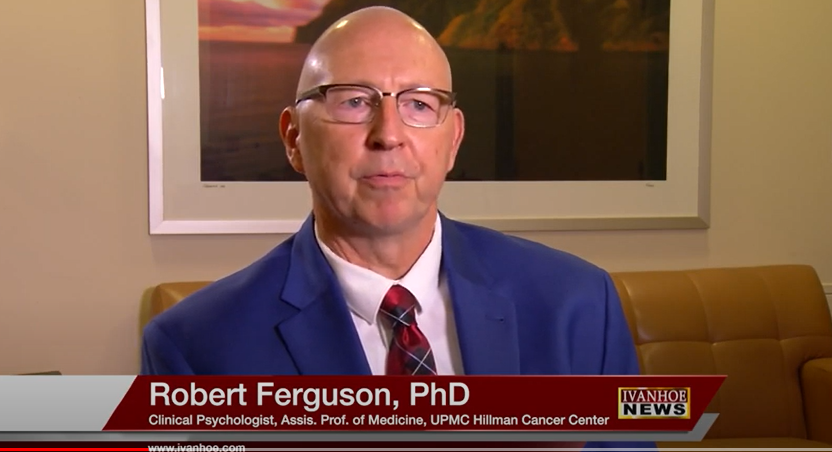
Robert Ferguson, PhD, Assistant Professor of Medicine, Clinical Psychologist, Division of Hematology and Oncology in Department of Medicine at University of Pittsburgh School of Medicine, talks about a specialized therapy designed to improve the memory of breast cancer patients.
What is chemo brain and why does it happen?
FERGUSON: Cancer related cognitive impairment, or chemo brain, is a set of memory problems usually with verbal memory such as recalling words. It can also impair attention like being able to focus on conversation or what you might have read, as well as working memory like remembering why you walked into a room or forgetting a phone number that was just told to them. This can happen in about half of all cancer survivors. Commonly it was believed that this was a result of the toxicities of chemotherapy that would affect the central nervous system and brain. However, over the last three decades, we’ve found that it may be the cancer itself, even though it may not be in the central nervous system. So, breast cancer, prostate cancer, the presence of cancer in the body may start an immune system response, or inflammatory response. For example, we found that before initiation of treatment, almost 40 percent of breast cancer survivors in one study done a long time ago, had some mild cognitive impairment as assessed by objective neuropsychological tests. So, it may be the cancer itself or a combination of cancer and treatment.
Does it seem to be more prevalent for breast cancer patients? You mentioned both breast cancer and prostate cancer.
FERGUSON: We don’t know if it’s more prevalent among breast cancer patients, but over the course of three decades of research, the participants in the research have been primarily breast cancer patients. So, on the order of about 75 to 80 percent of all studies have studied primarily breast cancer. We know there is a prevalence in other cancer populations because those cancers have been studied. The cognitive effects are mild to moderate.
How much more severe is it for people who’ve had cancer?
FERGUSON: Usually these cognitive impairments are mild to moderate and more noticeable when the person is resuming their pre-cancer levels of functional activity. So, during treatment and during a stressful time, these memory impairments can be more pronounced, particularly when the person has experienced a lot of fatigue or maybe distracted by peripheral neuropathy pain and other toxicities caused by various cancer treatments. When the person’s resuming and getting back into their pre-cancer role such as school, work, or family obligations, that’s when some of these mild to moderate impairments are noticed. They tend to get in the way of good functional performance. For example, somebody who works in banking and finance may have difficulty transposing numbers from one spreadsheet to another on their computer, and in that interim, they forget where they are in a step. So, there’s a lot of backtracking, and this can be time consuming and impair productivity.
Is it a quality-of-life issue? Are people ready to step back into the life they had before and are having trouble?
FERGUSON: It really is a quality-of-life issue. For those people that have cognitively intense jobs and demand high performance and speed, this is where they can get into trouble with occupational functioning. Or household family members may tease the person with cancer for forgetting things or being forgetful and not remembering a conversation that was held before. Or they may be a source of annoyance for the family and cause friction. These functional downstream effects in occupation and family relations are real and happen and can have devastating effects on some people.
Have you and your colleagues designed something that can help people through this cognitive impairment?
FERGUSON: We have. Around the late 1990’s, we developed a cognitive behavioral therapy called memory and attention adaptation training. Cognitive behavioral therapy means modifying thinking, attitudes, and assumptions as well as behavior. The reason we took this approach is because there is a great evidence base of cognitive behavioral therapy being effective for all sorts of conditions such as insomnia and management of pain among cancer patients. We took this approach with memory problems because it isn’t enough to just do drill and practice. Usually, performance improves with computer assisted repetitive practice for the brain or brain exercises, but it may not generalize to daily activity such as, “where did I park my car?”, or “what was the action step I was supposed to take for the team and our team meeting today?” What we’ve done is target the performances in everyday life for which memory is used and help participants identify, and cancer patients identify, their at-risk situations. You learn compensatory skills to do whatever it takes to become more proficient at those valued tasks. So, it may be keeping an organized day planner. It may also be using internal skills such as verbal rehearsal or self-instruction, which is talking through tasks that involve steps.
You talked about verbal rehearsal and talking through steps. Are these two things that would help no matter what your profession is or what the situation is?
FERGUSON: Correct. These compensatory strategies can help anybody in daily life perform better in everyday tasks. We found with this cognitive behavioral therapy that when we’ve randomized people to the MAT training program versus supportive therapy, MAT has improved verbal and processing speed, memory performance, as well as quality-of-life, reduced numbers of symptoms self-reported on self-report questionnaires and improved emotional responses to the frustration that occurs when people have memory problems in daily life.
Can you walk me through the program?
FERGUSON: The cognitive behavioral therapy consists of about eight visits that are about 45 minutes in length. We’ve designed this so it could be delivered over telemedicine. The COVID-19 pandemic kind of proved our point, that we must go where cancer survivors are so they’re not traveling back to the cancer center after finishing active treatment and probably exhausting all their paid leave. They’re not going to take that time to see the cancer psychologist for eight visits. So, we must go to the home and use telemedicine to deliver this therapy.
Is it self-paced and something they can do at home, or is it with a licensed clinical psychologist?
FERGUSON: It’s usually with a clinical psychologist but can also be a counselor or occupational therapist who are trained in the MAT program. It’s not self-paced but there is a workbook that the survivor follows with this trained clinician in the eight video visits which most patients finish within eight weeks. Some people can go faster. In our research protocol, we’re more regimented and stick to the schedule of eight visits of 45 minutes a piece.
And what did you find with the study? How much of an improvement? Was it measurable?
FERGUSON: It was absolutely measurable. We had what we call an effect size. So, people had improvements in processing speed scored in our last clinical trial we did of about half a standard deviation. That means that the average spread of improvement was at least half of the average spread of baseline scores and processing speed as well as symptoms that people report in daily life.
Can you tell me what patients were saying after they were done?
FERGUSON: Many people reported satisfaction that this wasn’t a drug therapy, and they didn’t have to be offered yet another pill. Most cancer survivors have reported in my clinical work over the years that they prefer a non-drug therapy, although that can be appropriate for some people. The other area of satisfaction is learning more about how memory and attention works in daily life and to remember too that we have normal forgetting. What’s interesting about human memory is that it’s malleable, and it’s not intended to remember everything. Helping patients be aware that their memory failure may not be due to their cancer or chemotherapy or a cancer treatment, it may be due to simple inattention or being hungry or tired – and those are things we can modify. So many patients report a lot of satisfaction with understanding that these are factors that I can control, and if I’m more aware of my at-risk situations, I can do some things to modify that to prevent the memory problem or mitigate its effects on my daily life.
Now that you’ve gone through the testing, do you see the next steps rolling out on a larger scale?
FERGUSON: Yes. This clinical trial is comparing MAT with supportive therapy which is general counseling that has been demonstrated to help with quality-of-life and reducing the emotional impact of memory problems. We’re studying this both at Indiana University and here at the University of Pittsburgh and Hillman Cancer Center to do a large trial with multiple clinicians. We have multiple therapists in each site. We are looking for patients who’ve had stage 1, 2, and 3 breast cancer who’ve had chemotherapy and have memory problems related to that chemotherapy. We’re looking for people that are at least one year post chemotherapy to five years. So, there is this window that we’re looking for. We’re also excluding people who’ve had prior brain injury or a central nervous system disease such as brain tumor or stroke because those could be confounds on the study. Our primary aim is to establish efficacy with multiple clinicians at multiple sites. The other aim that we’re evaluating is the effects of both supportive therapy and MAT on the brain. We have reason to believe that MAT and supportive therapy can enhance frontal lobe brain activity which appears to be in compensation for damage that may be caused by the cancer itself or cancer treatment. We’ve hypothesized that and doing brain scans of about half of all patients that were enrolled in this study. The good news is this study can be done completely from home, which is a nice trial because we’re testing with neurocognitive testing over the telephone before MAT or supportive therapy and after MAT or supportive therapy. Then six months out, we want to know the durability of either MAT or supportive therapy. Those individuals who volunteer can come into the University of Pittsburgh or Indiana University where my colleague, Dr. Brandon McDonald, has an imaging center.
Is there a physical difference when you look at those brain scans?
FERGUSON: There are differences that Dr. McDonald and I discovered back in 2004 among identical twins. It’s since been replicated where individuals who’ve gone through breast cancer and chemotherapy tend to use more of the cerebral cortex to perform a working memory task while they’re in the scanner than age match and education match healthy controls. What we hypothesize is that the brain is compensating by activating more cortical or outside of the brain network to perform the same on the task. This may account for why many patients who go through cancer and have memory complaints during their busy lives will go to a clinical neuropsychologist. The problem is, we don’t know what they were scoring prior to their cancer. We got a baseline prior to treatment, but the problem may be that when the increased demands are on the person’s performance, that’s when we see the problems arise. So, there’s these very subtle deficits. It’s often the case that neuropsychological testing will be the same between people treated for cancer and those people who’ve never had cancer, but their self-report of cognitive symptoms is greater in the cancer group. We found that in several studies.
Is there anything I didn’t ask you that you would want to make sure patients and their families know?
FERGUSON: The first thing is a lot of patients have asked me, are these cognitive problems something where I’m going to decline over time? We don’t have long-term data to necessarily say people get into a degenerative memory problem. So even though these are mild and moderate cognitive impairments, they tend to be stable over time. There are some people that may have some cognitive decline but may have a genetic predisposition to that sort of brain disorder. The other thing I really want to point out to patients who are going into treatment is that it’s not everyone. Not all patients end up with cognitive problems after their cancer treatment. They should talk with their medical oncologist about making treatment choices and do the treatment choice that’s going to be lifesaving first. We’re working on this treatment approach so we can deal with the quality-of-life thing among people who have survived cancer. First thing is eradicating the cancer.
Interview conducted by Ivanhoe Broadcast News.
END OF INTERVIEW
This information is intended for additional research purposes only. It is not to be used as a prescription or advice from Ivanhoe Broadcast News, Inc. or any medical professional interviewed. Ivanhoe Broadcast News, Inc. assumes no responsibility for the depth or accuracy of physician statements. Procedures or medicines apply to different people and medical factors; always consult your physician on medical matters.
If you would like more information, please contact:
CYNDY PATTON
412-415-6085
Sign up for a free weekly e-mail on Medical Breakthroughs called First to Know by clicking here