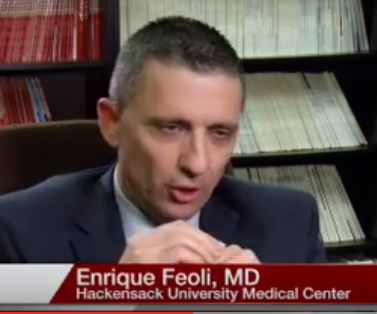
Enrique Feoli, M.D, a neurologist and epileptologist at Hackensack University Medical Center in Hackensack, New Jersey, talks about laser ablation surgery for epilepsy.
Interview conducted by Ivanhoe Broadcast News in April 2016.
For our viewers who have heard of epilepsy but aren’t overly familiar could you explain what is going on in a person’s system that’s causing seizures?
Dr. Feoli: Epilepsy is a medical condition defined by two or more unprovoked seizures. Let’s say you take a medication/drug you have a “provoked” seizure, well that’s not epilepsy right. The person is supposed to have two or more unprovoked seizures and that by definition is epilepsy.. There are a variety of conditions starting from brain tumors, brain scars, brain trauma, strokes, intracranial bleeding. Then there is a whole other group of patients that have epilepsy that the brain is normal structurally speaking. There is something wrong with their electrical impulses. These are patients that have a specific type of epilepsy or a special group of epilepsy called generalized epilepsy. For instance petit-Mal epilepsy or absence epilepsy, these are very common in children and if you were to do a brain MRI, the MRI is completely normal, the brain looks normal. However, their electrical impulses are abnormal and that generates seizures. There is a large number of conditions that could potentially cause epilepsy, but that’s a summary.
What treatments are most effective at this point?
Dr. Feoli: What’s most effective for the vast majority of people is medication. About seventy percent of patients respond to medications. The person develops epilepsy, you identify a medication that works for that particular patient and about seventy to seventy five percent of patients do extremely well with medication. That’s your first line of therapy: medication.
For the patients who can’t get effective control from the medication what are their options?
Dr. Feoli: About twenty five to thirty percent of patient’s medications don’t work. Then one needs to make a decision whether they are a candidate for epilepsy surgery or not. If not other therapies Like diet therapy, meaning you change what people eat and there is something called a ketogenic diet or the modified Atkins diet for epilepsy. You put patients on a constant fasting state because they eat very little carbohydrates and that controls seizures very well actually. There are other options like devices that could be implanted like the vagus nerve stimulator. That is a device that gets implanted in the chest and stimulates a nerve that goes to the brain and so that also controls seizures. They all have limitations and then there are better indications than others. The other big field is brain surgery. If a person has the type of epilepsy that you could potentially operate on then that’s an excellent option.
In terms of the newest, the lit, can you tell me what that stands for and where it fits in, in terms of treatment?
Dr. Feoli: Right. What you are talking about is the laser ablation or basically using laser to burn or destroy a lesion that causes epilepsy. This options is useful when you identify a person that has a scar in the in one part of the brain called the temporal lobe, this is just an example, you have two options with that scar, you could take it out with a regular surgical procedure or you could burn the scar and destroy the scar with laser ablation, the lit procedure right. Those are your two options. The laser generates heat and you create or you create a lesion that destroys the previous lesion with just heat. There is a high rate of seizure remission and seizure freedom with a surgical procedure. Either you take it out with a regular surgical; procedure or you can ablate the lesion with laser.
What is the benefit to the laser ablation over taking it out?
Dr. Feoli: The benefit is it’s a simpler surgical procedure. You don’t need to expose the brain; you make a small opening in the skull with a surgical drill. Then a laser probe is advanced in to the area of interest and then once it’s there you destroy the scar or burn the scar with heat. The benefit is a simpler surgical procedure and much faster recovery following the surgical procedure. The only limitation of the laser is you have to have a lesion to go after. Second, you have the potential of not curing the patient.
If that happens are there other options then?
Dr. Feoli: Then you go ahead with the regular surgical procedure down the road.
Have you had success stories using the lit?
Dr. Feoli: We’ve done two patients last year. The first person we’ve done was an older patient that, because of the age, we decided to go with a simpler neurosurgical procedure: less morbidity, less mortality, less complications. He was done about a year ago. He was taking three anti-seizure medicines, now he hasn’t had any seizures. He was having two seizures a month. Now we are decreasing his anti-seizure medicines so he’s now down to one anti-seizure medicine and hopefully in the next six months to a year he’ll be off all medications and hopefully he’ll remain seizure free. He was having two seizures a month, not able to drive; now he’s seizure free for about a year and a couple of months. He’s fully functional socially speaking.
Is there a point where this will become more of a standard, more neurosurgeons do you think will look to this?
Dr. Feoli: I think it’s just part of the resources we have. I’m not sure if it’s going to become first line. The conventional surgical procedure will remain the gold standard. These are other tools so far or other techniques that we have available for the right patients. The other patient we did was a patient with diabetes hypertension and multiple other medical conditions that you go for the simpler if such a word applies to a neurosurgical procedure. You go with something simpler that will cause less morbidity and less mortality.
Is there anything I didn’t ask you about this that you would want people to know?
Dr. Feoli: There is another indication that it has become the standard of care. There is a type of epilepsy that occurs in children or young adults that is caused by a tiny tumor in the hypothalamus. It’s called a hypothalamic hamartoma, the tumor is in a sensitive location and it’s usually very small. It’s deep in the brain so with regular surgical procedure you could cause a lot of damage. There are other options like endoscopic surgery, but also that could cause damage to the neighboring structures. For hypothalamic hamartoma laser, the laser oblation is becoming procedure of choice for neurosurgeons.
END OF INTERVIEW
This information is intended for additional research purposes only. It is not to be used as a prescription or advice from Ivanhoe Broadcast News, Inc. or any medical professional interviewed. Ivanhoe Broadcast News, Inc. assumes no responsibility for the depth or accuracy of physician statements. Procedures or medicines apply to different people and medical factors; always consult your physician on medical matters.
If you would like more information, please contact:
Mara Quigley
Public Relations
Sign up for a free weekly e-mail on Medical Breakthroughs called
First to Know by clicking here.