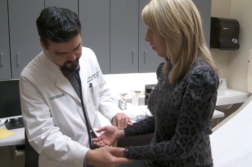
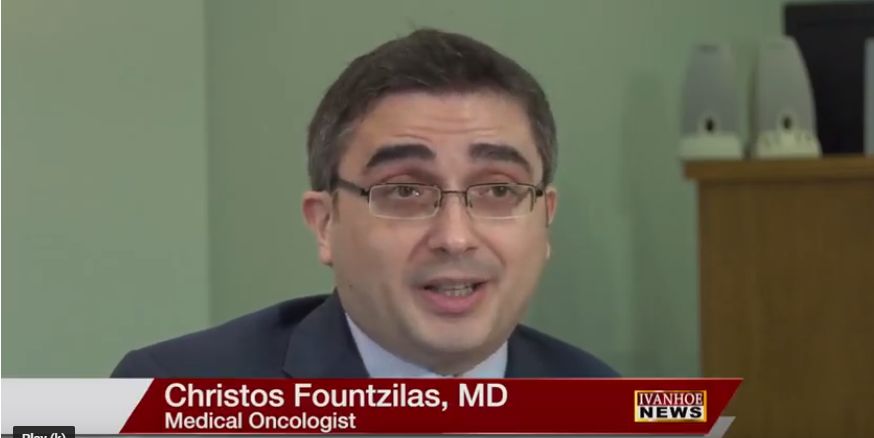
Christos Fountzilas, MD, a Medical Oncologist and Assistant Professor of Oncology at Roswell Park talks about pancreatic cancer and potential treatments.
Interview conducted by Ivanhoe Broadcast News in October 2018.
Talk a little bit about pancreatic cancer and why this is such a difficult cancer to treat.
Dr.Fountzilas: The usual type of pancreatic cancer is the pancreatic ductal adenocarcinoma. It’s the most common type of pancreatic tumor, and it is a difficult cancer to treat because number one, it give symptoms very late, usually when people get symptoms from pancreatic cancer have already advanced disease. And number two, the cancer itself has developed has many mechanisms to resist our best treatments.
So with that in mind, talk about why it’s so important to come up with alternative treatments for pancreatic cancer patients, which has a very low survival rate.
Dr. Fountzilas: We know that actually pancreatic cancer is going to be the second leading cause of death in the United States within the next ten years, so we’re desperate for new treatments. The techniques that we have right now, the treatment strategies that we have right now are much better than compared to ten years ago but definitely we’re not in a position to say we can cure pancreatic cancer. Identifying new strategies that can bypass mechanisms of resistance and do that with not a lot of side effects is the holy grail right now.
And a lot of the treatment really there aren’t many great treatment options are there for pancreatic cancer? And they’re very painful.
Dr. Fountzilas: The medical treatments that we have right now are definitely helping more people compared to what happened ten years ago, but there not many. We have a few treatment strategies, but when they these standard therapies stop working, we cannot offer something more. Definitely using multiple chemotherapy agents with pancreatic cancer can increase the risk of side effects. And so we need something better or we need to add something better to our existing treatments.
I want to go back to something you said earlier, you said that within the next ten years pancreatic diagnoses are going to increase, can you expand on that?
Dr. Fountzilas: Not exactly increase, but as we get better treatments for other types of cancers, their mortality is decreasing. At the same time, pancreatic cancer becomes more of a health problem. It’s the same thing as tuberculosis back in the 1800s. Tuberculosis was a major health issue. As we discovered treatments for tuberculosis, then heart disease started becoming a major problem.
It’s not so much the treatments have improved it’s that for pancreatic cancer everything else has improved?
Dr: Fountzilas: Exactly, exactly.
And that again comes back to late diagnoses.
Dr. Fountzilas: And not very effective treatments.
Is that due to the type of tumor itself, can you explain that?
Dr. Fountzilas: Yes, if you look at the same chemotherapy agents in other disease types, they’re much more effective compared to pancreatic cancer. And why is that? This is because number one the tumor cells by themselves have developed mechanisms to fight the effects of the chemotherapeutic drugs. One of which for example is that the chemotherapeutics cannot reach the tumor cells that effectively. When they reach the tumor cells effectively the tumor can bump them out. Using treatments that can help get more drug to the tumor, and not allow it to get out, and at the same time being selective enough not to affect healthy tissues is something that will definitely make things better for patients who suffer from this disease.
As a medical oncologist how encouraged are you by this FL118 and what have the studies shown so far?
Dr. Fountzilas: It’s really very, very exciting to see a molecule being able to be like a master regulator of multiple resistance mechanisms. I hope that in the next couple of years this agent is going to be in clinical trials we can see whether number one, it is safe, and number two, whether we can pair it with the existing treatments so that we make things better for patients with pancreatic cancer. This is an exciting time, to see those new drugs coming in to the clinic and being part of the clinical research program.
You’re dealing with the patients on a day to day basis so that must feel very good that you can tell them, well look at some of these things. It has to be a positive experience for you because you’re dealing especially with patients that are in a very difficult situation. So, explain how that feels for you.
Dr. Fountzilas: I’m always happy when I give them on top of the standard of care some clinical trial option. We have reached our limit with what we can achieve with what we have right now. I always encourage patients to look at clinical trial options. Always when I can offer them something that is different and that has a potential to help them more, that is exciting and good.
So how is your thoughts and your optimism for FL118 and what it can do?
Dr. Fountzilas: I hope that this drug is safe enough, and can affect multiple mechanisms of pancreatic cancer resistance so that we can pair it with our standard of care treatments and improve their efficacy.
What is your impression of the results that Dr. Lee has produced so far?
Dr. Fountzilas: The pre-clinical studies have really shown some very, very interesting results. Number one, this drug does appear to be a master regulator within the cancer cell. Number two, this drug does appear to accumulate in high concentrations within the tumor. Number three, it appears that for tumor models that developed a resistance to existing treatments, using this drug can restore sensitivity. This is what we’re looking from a cancer drug.
So if you had to sum that up it basically is killing cancer cells?
Dr. Fountzilas: It’s killing cancer cells, and it’s helping our treatments be more effective in killing cancer cells, even if these cancer cells become resistant to treatment.
Could you restate some of that?
Dr. Fountzilas: FL118 is an agent in the very early stage of development. We’re hoping that we can move this to the clinic within the next few years. What I hope this medication can do in patients with pancreatic cancer is number one, be safe. Number two, be able to kill cancer cells and help make the tumors sensitive to our existing treatments, even if they had developed resistance in the interim.
I don’t know if the study can determine this yet, but do you see it working as the primary treatment, the secondary treatment or a combination of both?
Dr. Fountzilas: It can work for both; it can potentially work as a sole treatment for pancreatic cancer, and it can make the existing treatments more sensitive.
So primary treatment, sole treatment?
Dr. Fountzilas: It can be the primary treatment, it can improve the efficacy of existing treatment, and it can restore the efficacy of existing treatments.
So there doesn’t seem to be any obstacle for this drug working at this point right? It’s just to keep repeating those results right?
Dr. Fountzilas: Always we want to see evidence of efficacy in patient in patients. We need to make sure that the medication is safe in humans. At this point, it looks like this is a safe medication, but we need to confirm that in human studies. We need to find the right dosing in humans, and we need to find what’s the best way to incorporate in our treatment strategy.
There probably haven’t been new treatments on the horizon. Is there one that’s developed significantly that’s had an impact in the last number of years?
Dr.Fountzilas: The last major, not really major, but the last approval for pancreatic cancer was three, four years back. Definitely, all the agents that we have right now are not curing pancreatic cancer. They can control pancreatic cancer, but they cannot cure pancreatic cancer. There are multiple agents that are in development right now, that appear promising. Can one of them be the answer for pancreatic cancer? Probably not. Not every patient is the same, not every tumor is the same. We need to be able to by analyzing the patient’s tumor to understand, what treatment strategy would be the ideal. For example, is it going to be targeting the tumor cell itself, is it going to be stimulating the immune system against the cancer? Is it trying to modify the architecture of the cancer? In order to do that we need to have the biomarkers that tell us which one to use which one the patient has a better sense getting benefit from.
So would you say that this potential treatment is the best one to come along in a number of years?
Dr. Fountzilas: I definitely hope so.
Is it the most promising?
Dr. Fountzilas: It’s definitely a very, very promising treatment.
END OF INTERVIEW
This information is intended for additional research purposes only. It is not to be used as a prescription or advice from Ivanhoe Broadcast News, Inc. or any medical professional interviewed. Ivanhoe Broadcast News, Inc. assumes no responsibility for the depth or accuracy of physician statements. Procedures or medicines apply to different people and medical factors; always consult your physician on medical matters.
If you would like more information, please contact:
Annie Deck-Miller
716-845-8593
annie.deck-miller@roswellpark.org
Sign up for a free weekly e-mail on Medical Breakthroughs called First to Know by clicking here.