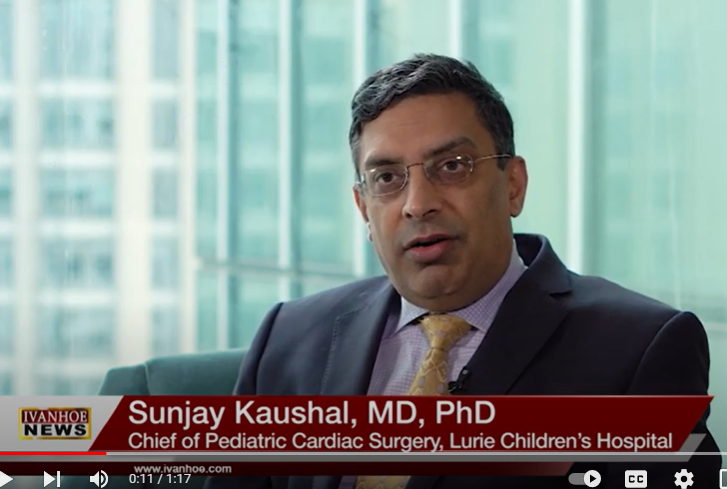
Dr. Sunjay Kaushal, MD, PhD, chief of pediatric cardiac surgery at Lurie Children’s Hospital at Northwestern University, talks about how stem cells are saving the lives of babies born with a heart condition.
Interview conducted by Ivanhoe Broadcast News in May 2022.
What is hypoplastic left heart syndrome?
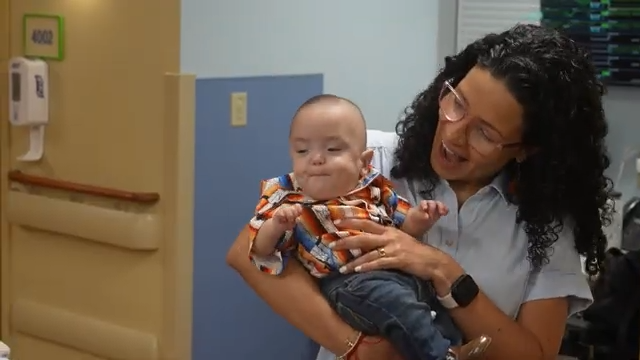
DR KAUSHAL: Hypoplastic left heart syndrome is a complex congenital heart disease. It is where the left ventricle does not develop. So, we sometimes say that the babies have half a heart. They only depend on their right ventricle to pump blood to the circulation. These babies need surgical intervention in the first weeks of life.
Is this happening before the babies are born?
DR KAUSHAL: Now, we can pick up close to about 80 to 90 percent of congenital heart disease in fetal life. We know already and can inform the parents about their little baby’s condition before they’re even born. And this allows the team to be ready for the surgery, as well as preparing for the delivery.
How does this impact the baby?
DR KAUSHAL: Babies with hypoplastic left heart can breathe. They look like normal babies. However, when you look at their hearts, you find that they have only half a heart. They have the right ventricle, but they don’t have the left ventricle. So, in the first few weeks of life, they need an operation to stabilize that physiology, to make that physiology work for that baby. They have a Norwood operation. In there, we do an operation where we create new connections within the heart. And that allows the baby to live. And then, they come back at four months of age for a second operation, called the Glenn operation. And then, they come back for a third operation, the Fontan operation. So, within three years, they have three different operations. They can live well during these operations. But long-term, what they develop is that right heart failure. That right ventricle becomes tired. It doesn’t pump blood efficiently. Those babies suffer. They can’t run around the playground. They can’t play with their siblings. They can’t eat. In those situations, then, you have to look at other modes of therapies.
What would those other therapies be?
DR KAUSHAL: Those therapies can include medicines which helps the heart to pump more efficiently. Or it can be a device which helps to assist the heart to pump efficiently. And last, is a transplant which replaces the whole heart and gives them a new heart to live. What we’re trying to do with stem cell-based therapies is trying to boost or regenerate that right ventricle. That ventricle, where it becomes dysfunctional, can’t pump blood to the body. We’re trying to see if we can put stem cells in there to remodel, rejuvenate that right ventricle to pump blood more efficiently for that baby.
Does that happen in the second surgery?
DR KAUSHAL: Yeah. Our current approach is during the second operation, we inject those cells directly into the heart. In that way, the cells can sit there and remodel the heart tissue to make it more efficient. That’s what we’re trying to do.
Without this, what’s the mortality rate for these babies?
DR KAUSHAL: In the first year of life, the survival rate is around 80 to 85 percent. When you look at five-year or 10-year survival, it is roughly around 65 percent. So, those babies need help. They need some type of support to make them live longer. And that’s what we’re trying to do with stem cell-based therapies.
Are all these surgeries open-heart surgeries?
DR KAUSHAL: Yes. So, all these three different operations, I call them heroic operations, are all open-heart surgery. That means the chest needs to be open, the heart needs to be exposed, and we have to use a bypass machine in order to do the work on the heart.
Are the stem cells implanted during the second surgery?
DR KAUSHAL: Yes. During the second surgery, before coming off bypass, we inject the cells directly into the heart.
So, you’ve already injected these cells in over 30 kids, right?
DR KAUSHAL: Yes. So, we have done the phase one study, which is looking at the safety and feasibility of injecting cells into the heart. We noticed that they reach those endpoints. There are no issues of safety or feasibility, and that’s very important to make sure we do no harm for our babies. We’ve done it in about roughly 24 patients. We’ve done it with two different stem cell types, and in both stem cell types have shown that they’re safe and it’s feasible to inject cells into the heart. Now, we’re looking at the phase two studies where we’re trying to understand, are they efficacious? Meaning, do they work? Do they improve the heart? And those studies are ongoing. We’ll know the results probably in about another two to three years. So, I think that these studies could be game-changing for our babies. They can really change the life expectancy, can improve that heart and make little Johnny run around the playground to play with his friends.
Do you see these kids living into their 30s, 40s, 50s, where they never would have before?
DR KAUSHAL: Yeah. So, most of these babies live into their 20s, but they’re struggling sometimes. I want them to live into 30s and 40s. And we’re hoping that if we can keep that right ventricle functioning at a very high level, that they can live that long.
Does this mean that more stem cells would be needed? More implants?
DR KAUSHAL: Yeah. So, we’re thinking more along the lines that it’s a drug now. That you just don’t need to give one dose, you have to give maybe multiple doses to get the true effect of these cells. So, we are looking at whether we need to give multiple injections into the heart or into the veins of little babies.
That’s amazing, right? I mean, to think that you’re doing that, and you think you’ve seen everything in medicine and then you come across this and you’re like, wow. You’re giving these kids that didn’t have a chance at life.
DR KAUSHAL: I think that’s probably what makes me go every day, it’s trying to figure out new therapies for these children. I’ve been working on this for over a decade, first in the laboratory trying to understand some basic questions, whether the cells work from little babies. And then, once we had gathered enough information, we went to the FDA to get a protocol approved by them, which they eventually did. And now, we’re in the throes of trying to figure out whether the cells will work. And I think that’s what is so exciting about this study.
Many of these patients do end up needing heart transplants, right? So, could this potentially prevent that?
DR KAUSHAL: Right. So, what we’re trying to do is prevent heart transplantation, which is the only option in babies that have heart dysfunction. Heart transplantation is a good option, but it carries associated risk. So, we’re trying to prevent that to keep them as living as normal lives as possible.
I would think getting a transplant heart as an adult is hard. Do you think it would be even harder as a baby?
DR KAUSHAL: Yeah. The waiting lists are long, and sometimes babies do suffer from morbidities because they have to wait so long.
Sometimes they even need a second one later in life, right?
DR KAUSHAL: Yeah. So, when you look at a baby, if a baby gets a heart in the first 10 years of life, they’re probably looking at probably two to three hearts in their whole lifetime. So, it’s not just you get one heart and you’re all good. You probably need another heart in the future.
Why is that?
DR KAUSHAL: Because they get rejection. So, the heart, even though is pumping well in the first few years of life, there’s rejection that occurs. And the rejection is not in the muscle tissue, but in the coronary arteries. The small vessels that feed the heart, they sometimes get clogged up and that leads to the heart muscle being affected. So, it’s not a cure to get a heart transplant. It’s not perfect. But it is an option.
END OF INTERVIEW
This information is intended for additional research purposes only. It is not to be used as a prescription or advice from Ivanhoe Broadcast News, Inc. or any medical professional interviewed. Ivanhoe Broadcast News, Inc. assumes no responsibility for the depth or accuracy of physician statements. Procedures or medicines apply to different people and medical factors; always consult your physician on medical matters.
If you would like more information, please contact:
Julianne Bardele
(312) 227-4265
Sign up for a free weekly e-mail on Medical Breakthroughs called First to Know by clicking here