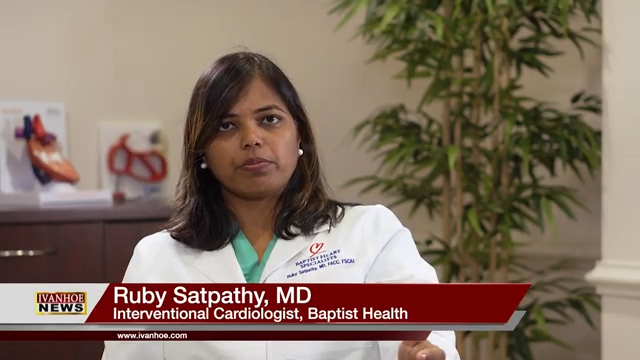
Baptist Health interventional cardiologist, Dr. Ruby Satpathy, MD talks about a new treatment for AFib.
Interview conducted by Ivanhoe Broadcast News in December 2022.
Let’s talk about A-fib, is it just being diagnosed more?
SATPATHY: I think it is more common. We just didn’t know about it. I think it is being diagnosed more. People are more aware of it. We didn’t have as much treatment for A-fib before as we do now.
What is it and how does it affect people?
SATPATHY: People have A-fib when they have any heart problems A-fib is a symptom not a disease, usually it’s a symptom because our heart is failing. You have heart failure, you have valid problem, you have aortic stenosis, valvular leaky problems or narrow problems and your heart goes into the A-fib. It’s a manifestation of a disease. People get more tired, short of breath, fatigue, the field palpitation. We have two different types. I call them the right-hand and the left-hand. A-fib one is controlling the heart rate and rhythm, keeping in regular rhythm or heart rate control and not have 120 or 180 and that we can do with medicine, or we can do ablation type of procedure. That is my electrophysiology colleagues. They go in with a catheter and burned areas to take care of the rhythm. The left side is the stroke. That’s the biggest scare. People are scared. They would rather die than have a stroke, so we recommend blood thinner. 15 years ago, we did not have any options, the only option or alternative of a blood thinner was open heart surgery. Our heart has a little appendix, just like an appendix in the belly. It’s a little pouch. That’s where blood gets in. It does not move and forms a clock and goes up next time to the brain causing a stroke. For surgeries, we have two devices. A blood thinner, where we keep bleeding. If we don’t, we have a stroke, so this is an alternative called the appendix closure, either with watchmen or amulet. These are relatively new to most people. I have been doing this for almost 15 years. I was one of the original PIs for research for both watchmen and amulet products. They are two different types of devices that do the same thing. They are just different safe plugs to take care of the appendix.
Tell me how the amulet works.
SATPATHY: The amulet is a device that shows ideas of the depth. I did a press conference when it got FDA approved and I was one of the first ID study that happened, in 2015. We were one of the top enrollers for the study here in Baptist. I did the first ever as a part of the ID trial, then it got FDA approval.
Was it the first ever in the country?
SATPATHY: We were the first in Southeast United States. Then the next phase is now doing amulet in patients. The first one was approved for people who cannot take blood thinners. As an alternative, like we’re talking about. Now, everybody wants those devices because they don’t want to be on blood thinner. It affects quality of life. If somebody does scuba diving, surfing, mountain biking, or even for works professions that can get them into accidents. Now we have studies that are looking into comparing the amulet versus people who can take blood thinner. That’s called catalysts trial. When it got FDA approval, we had a press conference and people asked the same question, how is it different? The best thing is it has a dual closure system. It has a little plug that takes in the appendix and basically closes it just like watchman does, but it also has a disk on top of it and that basically sits on the surface or the ostium opening of it. It has a dual closure system. That’s what we store in our studies.
Why is that better?
SATPATHY: The idea is you’re trying to reduce blood flow into the appendix so blood won’t go there now will be in the heart, will heal over it and that’s how clot. Zero leak is ideal. The less leak is better in amyloid got a more 100 percent closure, which means zero leak.
So that’s a door and then a storm door.
SATPATHY: Yes, that’s a good analogy. A door and the hurricane, the center. The second thing, what the advantage of amylin and this as I said in a year ago as well, and we just had a discussion at our national meeting again. The design of this device, the disk, the storm door. It’s very similar to PFO and ASD and VSD devices. These are devices that we use for holes in the heart, different places in the upper chamber, atrium, ventricle. We have been using this device forever. We have been putting these devices in little kids that have grown and they are probably 50, 60 now. We know these devices heel, we have real-time experience. The one of the things that has come up is what happens when we put these devices in the heart, like watchman over a period. It’s a foreign device. Does it form clot on top of it? It’s called a device related thrombosis. If it doesn’t close completely, can it form clot on the device? Those concerns are less spatulate because the disc is the exact same disc as the other devices that we have been using for 50 years in humans. What that has done take us to the next step is the requirement of blood thinner. After we put in a plug-in, we started 10 years ago saying that everybody needed to be on Coumadin for six weeks. That’s when watchmen got to prove first in 2013. Then we did aspirin and Plavix for four months. To the point that we did, we can do all the non-Coumadin blood thinners like Eliquis, they’re all sebaceous Pradaxa. Instead of Coumadin, we have data, we call DOAC direct. People like that because nobody wants to be on Coumadin, they hate to be on Coumadin. But there are a lot of people who don’t want to be on any blood thinner.
And is it costly?
SATPATHY: It is very expensive. Then there is the bleeding, and once they believe they must come off it. Internal bleeding is higher than Plavix. With Amulet we know that it heals faster because of our experience with the other. I think that made us more comfortable and the source data has shown that you do not need to be on any blood thinner from day one.
Why put people on blood thinner at all? Why not do the watch on or the ambulate?
SATPATHY: After we do the device, they must be on the short-term blood thinner to help the endothelial layers in healing process. With watchmen he was either Coumadin or the other blood thinners for a six-week period. That’s when we bring them back and do a T to make sure they heal. Ninety five percent of people came up to blood thinner at the time. Then they go on aspirin Plavix. With Amyloid, they don’t have to do that phase at all. We go on aspirin Plavix from day one because we know that it heals faster. The FDA has now approved and we’re doing the study in the catalyst because on every European data, it was only three months Plavix instead of six months Plavix, not just no blood thinner at all. It doesn’t matter if it’s one day or 2045 days. They are worried to get back on that pill anyway. Those are the ones that really love having not to take blood thinner at all go on only aspirin, Plavix and that’s also the very short period of time.
Were you talking about Doug? What surprised me is I had never known that you can go into a fit and not even know you’ve been in A-fib.
SATPATHY: Eighty percent of people don’t feel A-fib.
How do people even find out they have it then?
SATPATHY: Unfortunately, the first symptom might be stroke. That is the hard part about A-fib and that’s why we like to diagnose them sooner before they have a stroke, so that we can take care of it and prevent the stroke.
Have these wearable devices alerted some people?
SATPATHY: Yes, there is some data and it was published in one of the national meetings about two years ago.
Were you the one who found that Doug had an A-fib?
SATPATHY: It was Dr. Bora. He found the A-fib, and I think he found actually on some wearable device that he was wearing and then sent him my way for doing the device. Because he had intracranial bleed, he was not a good candidate for blood thinner, and I had the option of doing either one, Watchman or Amulet. We’re the only one in Jacksonville Metro or Northeast Florida that has both devices.
Now, we don’t have to get it replaced or anything in the future, it just happens and then it is A-fib cured?
SATPATHY: No. This does not cure A-fib. The A-fib prevents stroke, this reduces or eliminates bleeding because now you’re not on blood thinner, you’re only on baby aspirin. Eighty percent of people don’t feel their A-fib, so we just do medicine to keep their heart rate under control. Twenty percent of people feel the A-fib, those are the ones that we do an ablation procedure to fix the A-fib or control the A-fib. The Watchman or Amulet device did not cure A-fib. They take care of stroke and bleeding problems.
Does he have a pacemaker?
SATPATHY: Yes. He does have a pacemaker. There are different monitors to go back to. There is implantable, the pacemaker we do for pacing reasons or bradycardia, low heart rate, but they also monitor. There is an implantable loop recorder, that we use more often now than we did five years ago. It’s something that we put underneath the skin that can stay up to three years, and we get data from it constantly. Then people can wear monitors 24 hours, 48 hours, or one month. Then there are all the smartwatches. We recently did a live case for Amulet for our international conference in DC. Because it’s very new to most operators, we did a case from our structural heart lab. Both devices are very good. Depending on the shape of the appendix, it’s like we have TAVRs. Now we have three different companies that make TAVRs. We always say that depending on the anatomy, we’ll do what’s right for you.
How is it implanted?
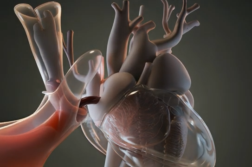
SATPATHY: This is our heart we were talking about, so we’re coming from the left, from the vein. This catheter is about as big as my little finger. We are going through the vein instead of the artery so that’s less bleeding risk. We are coming around and doing a trans septal. Basically, we’re going through the wall up there between the two upper chambers and we do now radio frequency ballast catheter. Instead of poking, we’re making a very controlled bar with a little radiofrequency so it’s much safer. We go to the other side, and this is where the little pouch is. There is a lot of muscular force and that’s where blood clots happen. We are going in and putting this plug as you can see. Then there is the lobe here, and then there’s a storm door that we’re talking about, the disk. What we do is, the lobe is inside so it’s closed. Then the disk that’s on the surface, like an extra storm door that closes. Our goal is zero flow. Flow goes in there, then it heals better and there’s no chance of forming a blood clot.
END OF INTERVIEW
This information is intended for additional research purposes only. It is not to be used as a prescription or advice from Ivanhoe Broadcast News, Inc. or any medical professional interviewed. Ivanhoe Broadcast News, Inc. assumes no responsibility for the depth or accuracy of physician statements. Procedures or medicines apply to different people and medical factors; always consult your physician on medical matters.
If you would like more information, please contact:
Wesley Roberts
Sign up for a free weekly e-mail on Medical Breakthroughs called First to Know by clicking here