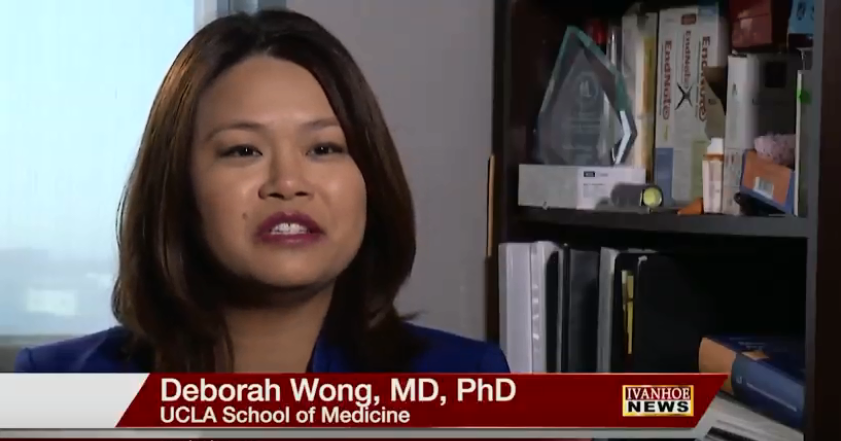
Deborah Wong, MD, PhD, Assistant Clinical Professor of Medicine at the UCLA Jonsson Comprehensive Cancer Center,, specializes in Internal Medicine and Hematology/Oncology, discusses a clinical trial underway using a combination of immunotherapy drugs to treat certain cancers, specifically melanoma and cancer of the head and neck.
Interview conducted by Ivanhoe Broadcast News in October 2018.
Let’s talk a little bit about the trial.
Dr. Wong: As many people are well aware, a class of drugs called immune therapy has really revolutionized treatment for some patients with some cancers, in particular melanoma. One of the big breakthroughs, using melanoma as an example, was the finding that if we use drugs that can cut the brakes on the immune system, thereby restoring it, we can harness the patient’s own immune system to attack the cancer. Two of the drugs that really have revolutionized treatment for patients with incurable melanoma are pembrolizumab and nivolumab. These drugs target a pathway called PD1/PDL1. Although they’ve been revolutionary for some patients,about forty percent of melanoma patients will respond to these drugs.For the patients that do respond, it’s a big life-changing treatment. Of course that leaves a large percentage of patients who still don’t respond to the treatment, and even among the forty percent who do respond initially, sometimes the cancer figures out how to develop resistance and grow back. So there’s a lot of research that’s been ongoing at UCLA and institutions to try to understand what is it about the patient, the drug, and the cancer that allows them to respond to the treatment. What happens to the tumor and the immune system that causes resistance? And in the patients who never respond, what can we do to try to improve that? One of the strategies that we have been testing is using a combination of a drug that is injected directly into one of the tumors called SD101 in combination with pembrolizumab.
And it’s basically a door opener?
Dr. Wong: Exactly, exactly. The idea is that the pembrolizumab infusion is there to kind of turn on the immune system and get it rearing to go. But there’s something about some cancers that just prevent the immune system from stepping on the gas to kill the cancer. And so what we’re finding is that perhaps in some patients this injection into one of the tumors is that thing that allows the immune system to step on the gas toreally drive and turn on the immune system, allowing the drugs to work together to shrink the tumors.
You only have to go to one tumor?
Dr. Wong: Yes the amazing thing is in the study we’re allowed to inject a number of tumors, up to four in some cases. Not everyone has multiple tumors that we inject, but many patients have multiple tumors, both ones that we can see and feel on the skin which are the ones that we may inject, as well as tumors internal to their body. What we’re finding is not only does this combination work to shrink the tumor that we’re injecting, but on scans the tumors far away from the ones we’re injecting, also shrink. That’s the really amazing part. Not only that, among the patients who respond, many of them have had ongoing responses. They’re still on treatment even going beyond a year and they’re doing well living their life normally with very minimal symptoms. For these patients, it’s life-changing.
So the trial has been going on for more than a year?
Dr. Wong: It has.
How long will it go on?
Dr. Wong: At this time we’re continuing to recruit melanoma patients. The study is also recruiting head and neck cancer patients, which is another very serious devastating illness.
The agent SD101 tell us about that, what is that?
Dr. Wong: SD101 is a synthetic oligonucleotide meaning it’s made up of the nucleic acids similar to or the same nucleic acids that make up our DNA in our genetic code. What happens is these short strings of oligonucleotides, when injected, activate the immune system, allowing immune cells to send an inflammatory signal saying, ”Hey we have something here we need to react to.” Not only does it send inflammatory signals but it also recruits other immune cells to that tumor site. Interestingly this string of nucleic acids is very similar to what our immune system recognizes in bacteria and viruses. It’s a way to kind of recapitulate or use our own immune system’s mechanism of recognizing foreign things to recruit immune cells.
It’s kind of a nudge, if it’s going to work, it’s nudge the body to say okay, turn on.
Dr. Wong: Yes, it recruits more immune cells, which are the fighter cells that actually fight the cancer, and bring them to the site of the tumor. Maybe like sending up a flare for the immune system.
What kind of results are you seeing so far?
Dr. Wong: Among the melanoma patients who have not had pembrolizumab or PD1 immunotherapy before, seven of nine patients had tumor shrinkage. That’s seventy eight percent, almost eighty percent. It’s a very small number but if you think about what we discussed in terms of the expected response for just pembrolizumab alone this may represent an advance, a vast improvement from that. The great thing is that patients in general not only have few side effects, if any, but also that many of the patients are continuing on treatment. Mr. Gilligan for example has actually just recently celebrated his one year anniversary on this treatment and is continuing on therapy.
Are the parameters of the trial one-year then?
Dr. Wong: No the patients continue on treatment while they’re doing well and benefitting from the treatment.
Until it stops working they can stay in the trial?
Dr. Wong: Yes and hopefully that’s on an ongoing basis long term.
So pembrolizumab alone works in about forty percent. Pembrolizumab plus the SD101 takes it up to seventy percent?
Dr. Wong: Seventy eight percent in this study among a small number of patients.
Among the patients who had never had immunotherapy before?
Dr. Wong: Yes.
What about people who have had immunotherapy?
Dr. Wong: In the group of patients that were tested, a smaller proportion of patients had already been on pembrolizumab or a drug like it, and responses were also seen there. More modest, maybe around fifteen percent.
Increase over the forty percent or fifteen percent total?
Dr. Wong: These were people who already had been treated with the pembrolizumab.
Fifteen percent period? Not fifteen plus forty?
Dr. Wong: Correct.
So it’s better if you’ve never been on it before?
Dr. Wong: It’s hard to say of course. We have to do further research to truly understand what is the contribution from the injection in combination with the pembrolizumab versus pembrolizumab alone. Hopefully those studies will be coming in the future.
These combinations therapies is kind of the way that everybody is going.
Dr. Wong: Yes, indeed. What we’re learning is that each cancer is unique in its genetic makeup. So one patient’s melanoma may be very, very different than the next patient’s melanoma. In addition, one patient’s immune system may react differently than another’s. Thereforewhat makes the cancer grow andwhat treatments it will respond to may be unique for each person. So we’re having to tailor cancer therapies to each patient, be it chemotherapy, targeted therapies, or immune therapies. The goal is to figure out what is it about the cancer that makes it grow, so we canfind the best strategies to employ and attack it?
Who is eligible to get into the trial?
Dr. Wong: Patients with melanoma, and head and neck cancer who have tumors that we can inject in the clinic.
That’s it, they can have had therapy before or not?
Dr. Wong: Yes.
Side effects?
Dr. Wong: Because the SD101 drug is designed to recruit our immune cells to the site of the tumor, the most common side effects are injection site reaction: redness at the injection site, and some swelling, and also flu-like symptoms. When we have an infection our body’s response is to cause fever and chills as a sign that our immune system is trying to fight that infection. In that same way the injection is designed to do that but to the cancer. So patients who have had the injection sometimes will experience fevers, chills, muscle ache, nausea, similar to what we feel when we have the flu.
I know that KEYTRUDA can cause in a terrible case autoimmune disease, now you’ve got two immunotherapies so is that a higher risk?
Dr. Wong: What we have found is that in general we aren’t seeing a lot more immune related toxicities from this combination compared to KEYTRUDA alone. The amazing thing is although we can see these very serious autoimmune side effects, in general, most patients on immune therapies really tolerate the treatments well and have pretty minimal side effects.
Anything you want to share about our patient before we chat with him?
Dr. Wong: Mr. Gilligan is amazing. He initially presented over a year ago to our clinic with a tumor on his left shoulder as well as findings of spots within his body; in the lungs and on a gland above his kidneys called the adrenal gland. Because he had this tumor that we could see and feel and inject, he was eligible for the SD101 / pembrolizumab combination study. We started him on treatment with that over a year ago. Since that time his scans, continue to showthat the tumors remain shrunken down and controlled and at the same time he’s still leading a very active lifestyle- He continues working full time and doing all his usual activities, basically with very minimal side effects. Perhaps the biggest side effect is the fact that he has to come in to clinic for treatment every few weeks.
Is there an end date for the trial?
Dr. Wong: There is not, so it’s continuing to recruiting until the cohort is filled.
END OF INTERVIEW
This information is intended for additional research purposes only. It is not to be used as a prescription or advice from Ivanhoe Broadcast News, Inc. or any medical professional interviewed. Ivanhoe Broadcast News, Inc. assumes no responsibility for the depth or accuracy of physician statements. Procedures or medicines apply to different people and medical factors; always consult your physician on medical matters.
If you would like more information, please contact:
Denise Heady
310-206-2805
Sign up for a free weekly email on Medical Breakthroughs called First to Know by clicking here.