ORLANDO, Fla. (Ivanhoe Newswire) — There are two types of macular degeneration: dry and wet. Dry age-related macular degeneration is the most common type — it happens when small deposits form under the retina, causing cells in the eye’s macula to die off. There’s currently no cure, but breakthroughs are on the horizon.
If you have dry age-related macular degeneration, your central vision may end up blurry, distorted or dim.
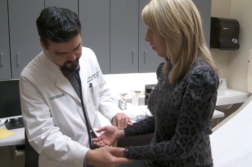
“It’s the leading cause of vision loss amongst American citizens,” said Christopher D. Riemann, MD, vitreoretinal surgeon at the Cincinnati Eye Institute.
And it gets worse over time.
“There’s no treatments that have been shown to actually improve vision, it’s a significant unmet need,” Dr. Riemann explained.
In 2023, the FDA approved the first medicine for advanced dry macular degeneration. SYFOVRE is given as an injection in the eye. While it doesn’t restore vision loss, studies show it can slow the progression of the disease.
“The dry macular degeneration is by far more common. It’s the 80 to 90 percent of patients with macular degeneration,” said Dr. Riemann
As part of a clinical trial, he is one of the surgeons testing whether injecting human retinal pigment epithelium cells into the eyes of patients can improve vision.
“We’ve seen patients that have regained some vision and that’s hitherto been unheard of with any experimental therapy,” explained Dr. Riemann.
Researchers from around the world are also studying whether an innovative electronic eye implant paired with augmented-reality glasses could help. In a clinical trial, 84% of participants were able to recognize letters, numbers, and words using the prosthetic vision in an eye that had previously gone blind. Scientific research that gives hope to millions who face vision loss.
The device that’s implanted is only two millimeters by two millimeters. It’s placed beneath the central retina through a small opening. Participants who tested it were able to read an average of five lines on a standard vision chart. Prior to the implant, several couldn’t even distinguish the chart at all.
Dry age-related macular degeneration encompasses 90 percent of all age-related macular degeneration cases. The other 10 percent are from wet age-related macular degeneration. According to Cleveland Clinic, wet AMD occurs when abnormal blood vessels grow under the retina and cause swelling and bleeding, and it always impacts the center of vision.
Contributors to this news report include: Julie Marks, Producer; Roque Correa, Editor.
Sources:
https://preventblindness.org/dry-age-related-macular-degeneration-amd/
https://www.sciencedaily.com/releases/2025/10/251020092818.htm
https://health.clevelandclinic.org/wet-vs-dry-macular-degeneration
* For More Information, Contact: Nic Johnson
NIC.JOHNSON@RUSSOPARTNERSLLC.COM
Free weekly e-mail on Prescription: Health from Ivanhoe. To sign up: http://www.ivanhoe.com/ftk